


.oi-article{font-family:system-ui,-apple-system,sans-serif;color:#1a1a1a;line-height:1.8;max-width:820px;margin:0 auto}
.oi-article h2{color:#0e4a6e;border-bottom:2px solid #0e4a6e;padding-bottom:8px;margin-top:35px;font-size:1.6em}
.oi-article h3{color:#1a6b8a;margin-top:25px;font-size:1.3em}
.oi-toc{background:#f0f7fb;border-left:4px solid #0e4a6e;padding:20px 25px;margin:25px 0;border-radius:6px}
.oi-toc ul{list-style:none;padding:0;margin:0}.oi-toc li{padding:5px 0}
.oi-toc a{color:#0e4a6e;text-decoration:none;font-weight:500}.oi-toc a:hover{text-decoration:underline}
.oi-tip{background:#e8f5e9;border-left:4px solid #2e7d32;padding:15px 20px;margin:20px 0;border-radius:6px}
.oi-warn{background:#fff3e0;border-left:4px solid #ef6c00;padding:15px 20px;margin:20px 0;border-radius:6px}
.oi-tldr{background:#e3f2fd;border-left:4px solid #1565c0;padding:15px 20px;margin:20px 0;border-radius:6px;font-size:1.05em}
.oi-cmp-table{width:100%;border-collapse:collapse;margin:25px 0;font-size:0.95em}
.oi-cmp-table th{background:#0e4a6e;color:#fff;padding:12px 10px;text-align:left}
.oi-cmp-table td{padding:10px;border-bottom:1px solid #e0e0e0;vertical-align:middle}
.oi-cmp-table tr:hover{background:#f5f5f5}
.oi-cmp-table img{max-width:80px;height:auto;border-radius:6px}
.oi-btn{display:inline-block;padding:8px 16px;border-radius:5px;color:#fff!important;text-decoration:none;font-size:0.85em;font-weight:600;margin:3px 4px 3px 0}
.oi-btn-amz{background:#f0960a}.oi-btn-amz:hover{background:#d4840a}
.oi-btn-ebay{background:#0654ba}.oi-btn-ebay:hover{background:#044a9e}
.oi-btn-ali{background:#e43225}.oi-btn-ali:hover{background:#c42a1f}
.oi-review{overflow:hidden;margin:25px 0;padding:20px;background:#fafafa;border-radius:8px;border:1px solid #e8e8e8}
.oi-review img{float:right;max-width:140px;margin:0 0 15px 20px;border-radius:8px}
.oi-pros-cons{display:flex;gap:20px;margin:10px 0}.oi-pros,.oi-cons{flex:1}
.oi-pros li{color:#2e7d32}.oi-cons li{color:#c62828}
.oi-faq dt{font-weight:700;color:#0e4a6e;margin-top:18px}.oi-faq dd{margin:5px 0 0 0}
.oi-disclosure{background:#f5f5f5;padding:15px 20px;margin-top:35px;border-radius:6px;font-size:0.9em;color:#555}
You’ve probably seen those countertop water distillers and wondered if they’re worth the hype. After testing systems for years and talking to homeowners dealing with everything from hard well water to city chlorine spikes, I can tell you they’re a unique tool. They’re not for everyone, but for the right person, they’re a game-changer. This guide covers what they are, how they work, and which models we’d actually put in our own kitchens.
What Is a Home Distillation System?
At its core, a home distillation system is a mini water treatment plant on your countertop. It mimics the natural hydrological cycle: boil water into steam, leave the impurities behind, then cool the steam back into pure liquid water. The result is H2O in one of its cleanest forms, stripped of minerals, heavy metals, bacteria, and most chemicals.
People often confuse it with other filters. But while an activated carbon water filter adsorbs chlorine and organics, distillation physically separates contaminants by phase change. It’s a brute-force method. The process is simple, but the engineering behind a good, efficient unit is where things get interesting—and where cheap models fail.
Think of it as the last line of defense. If you’re on questionable well water, have specific health requirements, or need lab-grade purity for appliances like CPAP machines or steam irons, a distiller delivers peace of mind that other methods can struggle to match.
How Home Distillation Works
The principle is straightforward, but the details determine efficiency and purity. Let’s break down the journey your tap water takes.
The Boiling Chamber
It starts in a stainless steel boiling chamber. You fill it with tap water, and a heating element brings it to a rolling boil. As the water turns to steam, it leaves behind dissolved solids—heavy metals like lead, arsenic, fluoride, and nitrates—as well as most bacteria and viruses. These contaminants stay in the chamber as a residue you’ll need to clean out later.
Condensation and Collection
The hot, pure steam rises and is channeled into a condenser. Here, cool air or water circulating around a coil causes the steam to lose heat and revert to liquid form. This distilled water then drips into a clean collection container, usually made of glass or BPA-free plastic. The key is a good condenser; poor designs allow steam to escape, reducing your yield and wasting energy.
The Post-Carbon Filter (Optional but Recommended)
Many better distillers include a small carbon filter cartridge the water passes through after condensation. Why? Volatile organic compounds (VOCs) with boiling points lower than water can evaporate and re-condense with the steam. This final carbon stage grabs those, polishing the taste and odor of your finished water.
Key Benefits of Distilling Your Water
Unmatched Purity: This is the headline. Distillation removes virtually everything that isn’t H2O. We’re talking 99.9% of bacteria, viruses, cysts, heavy metals, and dissolved salts. If your water report has concerning entries, distillation deals with them comprehensively.
Consistency: Unlike filters that can degrade or channels that can break through, a properly functioning distiller produces the same quality water batch after batch. You’re not relying on a filter’s micron rating or activated carbon’s remaining adsorption capacity.
Versatility: The pure water is perfect for more than drinking. Use it in automotive batteries, steam irons, humidifiers, and aquariums where mineral buildup is a problem. It’s also essential for certain medical devices.
Potential Drawbacks to Consider
Energy Use: Boiling water takes a lot of electricity. A typical 750W countertop unit running for 4-6 hours to make a gallon uses significant energy. It’s not the most eco-friendly option if you’re distilling all your drinking water.
Slow Output: You won’t get instant water. Most home units produce 1 liter per hour at best. You need to plan ahead and run batches. This makes it impractical as a whole-house solution.
“Flat” Taste: By removing all minerals, you also remove the elements that give water its taste. Many people find distilled water tastes flat or bland. You can add a pinch of mineral salt or use a remineralization filter to fix this.
Types of Home Distillers
Countertop Electric Distillers
The most common type for home use. These are self-contained units—boiling chamber, condenser, and collection jug in one. You plug them in, fill the tank, and press a button. They’re perfect for producing a gallon or two a day for drinking and appliance use. Most have auto-shutoff for safety.
Moonshine-Style Stills
These are the large, pot-and-coil systems you might associate with DIY alcohol. But they work perfectly for water distillation too. They have a much larger capacity (5+ gallons) and are often made of stainless steel and copper. They require a separate heat source like a gas stove. They’re for serious hobbyists or people needing larger volumes.
Non-Electric Stovetop Distillers
A simpler, often cheaper option. It’s basically a specially designed pot that sits on your stove. You boil the water, and a built-in condenser coil directs the steam into a collection vessel. They’re slow and require monitoring, but they have no electronics to fail and work during power outages.
Buying Guide: What Actually Matters
After testing dozens, here’s where we’d focus your attention.
Material is King: The boiling chamber and all water-contact parts should be 304 stainless steel. Avoid plastic chambers—they can leach chemicals when hot and stain over time. A ceramic filtration system is inert, but for distillers, stainless is the standard for durability and purity.
Condenser Design: Look for efficient cooling. Copper coils offer great thermal conductivity. Ensure the cooling water inlet and outlet are logically placed (in low, out high) for proper flow. A poor condenser means steam escapes and your yield drops.
Safety Features: Auto-shutoff when the water level is low or the unit overheats is non-negotiable. A built-in thermostat that cuts power at 115°C (239°F) prevents damage and fire risk.
Post-Carbon Filter: Get one that includes a final carbon stage. It’s a cheap addition that vastly improves the taste of the final product by removing any carry-over VOCs.
Capacity vs. Speed: A 4L unit making 1L per hour is standard. If you need more, consider a larger still, but know it will take longer per batch. Match the capacity to your daily usage.
Our Top Picks for 2026
| Product | Key Specs | Price | Links |
|---|---|---|---|
VEVOR Pure Water Distiller 4L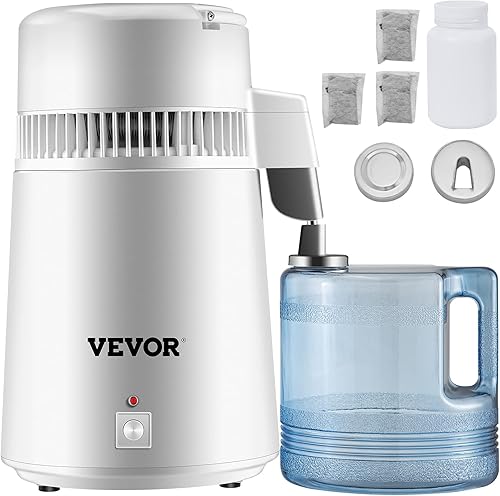 |
750W, 4L capacity, 304 stainless steel interior, auto-shutoff, aluminum fan | $94 | Buy on Amazon Buy on eBay |
Advwin 6L Water Distiller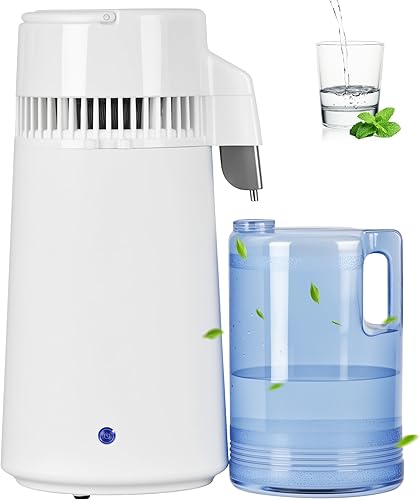 |
750W, 6L capacity, 1L/H output, auto-shutoff at 155°C, BPA-free container | $1.59 | Buy on Amazon Buy on eBay |
VEVOR Moonshine Still 5 Gal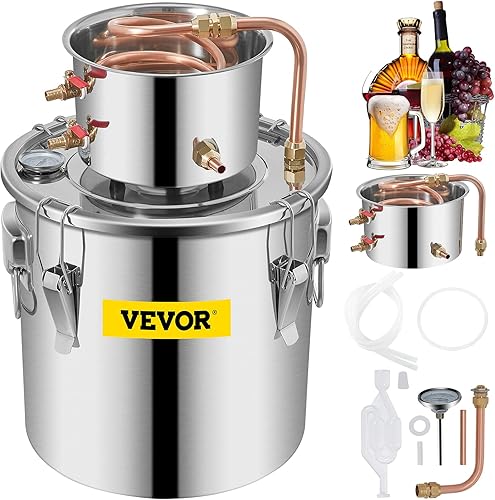 |
5.5 gal (21L) boiler, copper coil condenser, built-in thermometer, for stovetop use | $1.23 | Buy on Amazon Buy on eBay |
| KITGARN Moonshine Still 3Gal |
12L capacity, copper coil, open-type cooling, built-in thermometer | $1.11 | Buy on Amazon Buy on eBay |
VEVOR Pure Water Distiller 4L
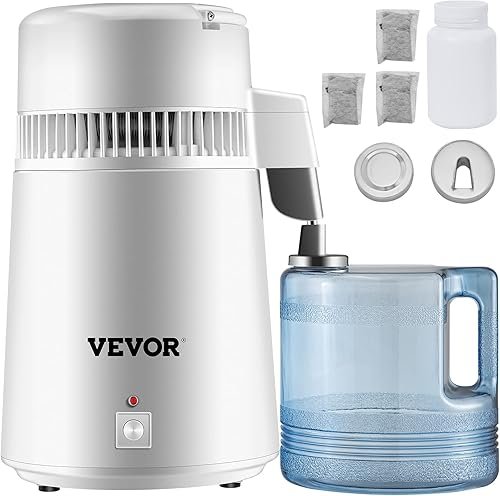
This is our top recommendation for most people starting out. The full 304 stainless steel interior is a big deal—you’re not getting plastic leaching into hot water. It’s straightforward: press a button, come back in 4-5 hours to a gallon of pure water. The auto-shutoff at 115°C is a critical safety feature we insist on. The aluminum fan blade upgrade over plastic is a small but meaningful durability improvement.
- All stainless steel water path
- Reliable auto-shutoff safety
- Simple one-button operation
- Good value for the price
- Plastic collection jug (common at this price)
- No included post-carbon filter
Advwin 6L Water Distiller
If you need a bit more capacity without jumping to a giant still, this 6L unit is a solid step up. The 1-liter-per-hour output is competitive, and the higher auto-shutoff temperature (155°C) suggests a robust thermostat. The included 6L BPA-free container is a nice touch—you won’t need to buy a separate jug right away. It’s a straightforward, no-frills machine that does its job.
- Larger 6L capacity
- Includes BPA-free collection bottle
- Higher temperature auto-shutoff
- Good output speed
- Less brand recognition than VEVOR
- Design is very generic
VEVOR Moonshine Still 5 Gal
This is for the hobbyist or someone needing larger batches. It’s a classic pot still design with a 21L stainless steel boiler and a copper coil condenser. The built-in thermometer is essential for monitoring your run. Remember, this isn’t electric—you’ll need a gas stove or outdoor burner. The copper coil provides excellent, rapid cooling. Honestly, it’s overkill for daily drinking water but perfect for a workshop, large aquariums, or if you just enjoy the process.
- Massive 21L capacity
- Excellent copper coil cooling
- Durable stainless and copper build
- Versatile for water or hobby distilling
- Requires separate heat source
- More hands-on and complex to use
- Takes up significant storage space
KITGARN Moonshine Still 3Gal
A slightly smaller version of the pot still concept at 12L. The open-type cooling with copper coils is efficient. If the 5-gallon VEVOR feels like too much, this is a good middle ground. The build quality is similar—stainless pot, copper coil, thermometer. It’s a solid, basic still for someone who wants to distill a few gallons at a time without a massive footprint. Just know you’re committing to a stovetop process.
- Good mid-size capacity (12L)
- Efficient copper coil condenser
- Includes thermometer
- Lower price point for a still
- Still requires a stove or burner
- Not for someone wanting “plug-and-play”
Frequently Asked Questions
- Is distilled water safe to drink every day?
- Yes, it’s perfectly safe. The main concern is taste and the lack of minerals. Since distillation removes beneficial minerals like calcium and magnesium, some people choose to add them back or ensure their diet compensates. For short-term use or specific needs, it’s absolutely fine.
- What’s the difference between distilled and purified water?
- Distilled water is a type of purified water, but not all purified water is distilled. Purification can include reverse osmosis, deionization, or carbon filtration. Distillation is a specific thermal process. Our article on distilled water vs purified water breaks down the nuances.
- How often do I need to clean my distiller?
- After every 2-4 uses, you should descale the boiling chamber. The mineral scale (limescale) left behind can reduce efficiency and eventually damage the heating element. A simple citric acid or vinegar solution works well. Wipe it out after each batch once it’s cool.
- Can a distiller remove lead and fluoride?
- Absolutely. This is one of its strongest suits. Both lead and fluoride are non-volatile and are left behind in the boiling chamber during the distillation process. The resulting steam is free of these contaminants.
- Why does my distilled water taste flat?
- Because all the minerals that contribute to “mineral” taste have been removed. Think of it like unsalted broth. You can improve the taste by adding a tiny pinch of high-quality salt or by using a post-filter that adds minerals back in. Some people get used to the neutral taste quickly.
- Is a ceramic filter better than distillation?
- They serve different purposes. A ceramic filter is excellent for removing sediment, bacteria, and cysts, but it won’t touch dissolved chemicals, heavy metals, or viruses like distillation will. It depends entirely on what’s in your water to begin with.
Final Thoughts
After years of testing, our stance is clear: a home distillation system is a specialist tool, not a general-purpose filter. If your primary concern is chlorine taste or sediment, a good carbon filter is cheaper and faster. But if you face serious contamination—lead, fluoride, nitrates, or biological threats—or you need water of guaranteed purity for health or technical reasons, distillation is hard to beat.
For most households, we’d recommend the VEVOR 4L Pure Water Distiller as the starting point. It hits the sweet spot of safety, material quality, and price. Start there, see if the process and output fit your life, and then decide if you need to scale up. The peace of mind that comes from knowing exactly what’s in your water—and more importantly, what’s not—is worth the electricity and the wait.
