


.oi-article{font-family:system-ui,-apple-system,sans-serif;color:#1a1a1a;line-height:1.8;max-width:820px;margin:0 auto}
.oi-article h2{color:#0e4a6e;border-bottom:2px solid #0e4a6e;padding-bottom:8px;margin-top:35px;font-size:1.6em}
.oi-article h3{color:#1a6b8a;margin-top:25px;font-size:1.3em}
.oi-toc{background:#f0f7fb;border-left:4px solid #0e4a6e;padding:20px 25px;margin:25px 0;border-radius:6px}
.oi-toc ul{list-style:none;padding:0;margin:0}.oi-toc li{padding:5px 0}
.oi-toc a{color:#0e4a6e;text-decoration:none;font-weight:500}.oi-toc a:hover{text-decoration:underline}
.oi-tip{background:#e8f5e9;border-left:4px solid #2e7d32;padding:15px 20px;margin:20px 0;border-radius:6px}
.oi-warn{background:#fff3e0;border-left:4px solid #ef6c00;padding:15px 20px;margin:20px 0;border-radius:6px}
.oi-tldr{background:#e3f2fd;border-left:4px solid #1565c0;padding:15px 20px;margin:20px 0;border-radius:6px;font-size:1.05em}
.oi-cmp-table{width:100%;border-collapse:collapse;margin:25px 0;font-size:0.95em}
.oi-cmp-table th{background:#0e4a6e;color:#fff;padding:12px 10px;text-align:left}
.oi-cmp-table td{padding:10px;border-bottom:1px solid #e0e0e0;vertical-align:middle}
.oi-cmp-table tr:hover{background:#f5f5f5}
.oi-cmp-table img{max-width:80px;height:auto;border-radius:6px}
.oi-btn{display:inline-block;padding:8px 16px;border-radius:5px;color:#fff!important;text-decoration:none;font-size:0.85em;font-weight:600;margin:3px 4px 3px 0}
.oi-btn-amz{background:#f0960a}.oi-btn-amz:hover{background:#d4840a}
.oi-btn-ebay{background:#0654ba}.oi-btn-ebay:hover{background:#044a9e}
.oi-btn-ali{background:#e43225}.oi-btn-ali:hover{background:#c42a1f}
.oi-review{overflow:hidden;margin:25px 0;padding:20px;background:#fafafa;border-radius:8px;border:1px solid #e8e8e8}
.oi-review img{float:right;max-width:140px;margin:0 0 15px 20px;border-radius:8px}
.oi-pros-cons{display:flex;gap:20px;margin:10px 0}.oi-pros,.oi-cons{flex:1}
.oi-pros li{color:#2e7d32}.oi-cons li{color:#c62828}
.oi-faq dt{font-weight:700;color:#0e4a6e;margin-top:18px}.oi-faq dd{margin:5px 0 0 0}
.oi-disclosure{background:#f5f5f5;padding:15px 20px;margin-top:35px;border-radius:6px;font-size:0.9em;color:#555}
You’ve heard the claims. “Purest water possible.” “Removes everything.” But what does an electric water distiller actually do, and is it the right choice for your kitchen counter? After testing units for over a decade, I can tell you it’s a specific tool for a specific job.
- What an electric water distiller is and how the process works.
- The real benefits and the significant drawbacks you need to know.
- A breakdown of the main types and what to look for when buying.
- Our hands-on reviews of popular models you can buy right now.
What Is an Electric Water Distiller?
An electric water distiller is a countertop or standalone appliance that mimics the natural water cycle. It heats tap water to its boiling point, turns it into steam, leaves virtually all dissolved solids and contaminants behind, and then cools the steam back into a liquid. The result is distilled water.
This isn’t just filtration. It’s a phase change. While a ionizing water filter alters water’s properties, distillation physically separates water from everything else. We’re talking heavy metals, bacteria, viruses, fluoride, and most chemicals. The output is H2O in its most literal sense.
Who actually needs one? Honestly, most people don’t. But for specific applications—like topping off lead-acid batteries, using in medical equipment like CPAP machines, or in laboratory settings—it’s essential. Some folks with extremely poor source water also rely on them.
How an Electric Water Distiller Works
The process is straightforward but clever. Let’s break it down into its core stages.
1. Boiling Chamber
You fill a stainless steel or glass boiling chamber with tap water. A heating element, typically between 500W and 1000W, brings the water to a rolling boil. This kills most pathogens immediately and creates steam. All the stuff you don’t want—dissolved minerals, lead, arsenic, salts—gets left behind as residue.
2. Condensation
The steam rises and is channeled into a cooled condenser coil. This is where the energy cost comes in. A fan blows air over the coil, or in some models, cold water runs through a jacket, forcing the steam to lose heat and revert to liquid form. This is pure distilled water.
3. Collection & Post-Filtration
The distilled water drips into a collection carafe, usually made of glass or BPA-free plastic. Many units include a small activated carbon filter in the drip path. This isn’t for primary purification—it’s a final polish to remove any volatile organic compounds (VOCs) that might have vaporized and re-condensed with the steam. It’s similar to how a carbon filter cartridge works in other systems.
Key Benefits of Distillation
Unmatched Purity: This is the headline. Distillation removes an incredible range of contaminants. We’re talking 99.9%+ removal of bacteria, viruses, heavy metals, nitrates, and most organic chemicals. If your water has a serious, specific contaminant, distillation is the surest way to get rid of it.
Consistency: Unlike filter cartridges that degrade over time, a properly functioning distiller produces the same quality water batch after batch. There’s no micron rating to worry about, no channeling in a ceramic filter cartridge. It’s physics, plain and simple.
Simplicity: No plumbing to install, no water pressure needed. Plug it in, fill it, press a button. Maintenance is mostly about scrubbing scale out of the boiling chamber every few weeks. It’s a self-contained unit.
Potential Drawbacks to Consider
Energy Hog: A 750W unit running for 4 hours to make a gallon uses 3 kWh of electricity. That’s not insignificant. It’s the least energy-efficient purification method compared to a carbon water filter or reverse osmosis.
Slow Process: You can’t get a glass of distilled water on demand. You have to plan ahead. A full 4-liter batch takes 4-5 hours. This makes it impractical as a household’s primary drinking water source.
Mineral-Free Water: The distillation process removes beneficial minerals like calcium and magnesium. Some argue this makes the water “aggressive” and leach minerals from your body, though the science on that is debated. The flat taste, however, is real.
Types of Distillation Systems
Countertop Electric Distillers
This is what we’re focusing on here. Self-contained units with a boiling chamber, condenser, and collection carafe. They’re portable, require no installation, and are perfect for small batches. Capacities range from 1 to 5 gallons per day.
Automatic Distillers
Larger, often plumbed-in units that connect to your water line and a storage tank. They produce water continuously and are used in labs or large aquariums. They cost significantly more, often $1000+.
Solar Distillers
A non-electric option using the sun’s heat. Very slow and weather-dependent, but great for off-grid survival or educational purposes. Not practical for daily use.
Buying Guide: What Actually Matters
Forget fancy digital displays. After testing dozens, here’s what moves the needle.
Interior Materials: This is non-negotiable. The boiling chamber, condenser coil, and all water-contact parts must be food-grade stainless steel (304 or 316) or glass. Avoid plastic interiors—they can leach chemicals at high heat. Look for FDA or CE certification.
Condenser Cooling: Aluminum fan blades are more durable and dissipate heat better than plastic ones. A stainless steel exhaust cover is another plus for longevity.
Boiling Chamber Capacity & Wattage: A 4L chamber with a 750W element is the sweet spot for home use. It balances batch size with reasonable boil times. Higher wattage means faster boiling but higher electricity draw.
Safety Features: Auto-shutoff when the boiling chamber is dry or overheats is critical. A thermal fuse is a basic safety must-have.
Post-Carbon Filter: A small activated carbon filter in the drip path is a good feature for removing any last traces of VOCs. It’s a final polish.
Top Electric Water Distillers for 2026
We’ve tested these units over multiple cycles, checking for build quality, purity output, and ease of cleaning. Here’s a quick comparison, followed by our detailed takes.
| Product | Key Specs | Price | Links |
|---|---|---|---|
 VEVOR 4L White |
750W, 304 SS Interior, Auto-shutoff, Aluminum Fan | $94 |
Buy on Amazon Buy on eBay |
 VEVOR 4L Silver |
750W, 304 SS & Glass, 1L/hr, Aluminum Fan | $133 |
Buy on Amazon Buy on eBay |
 VEVOR 4L Grey Glass |
750W, Dual Temp Display, Glass Container, Aluminum Fan | $152 |
Buy on Amazon Buy on eBay |
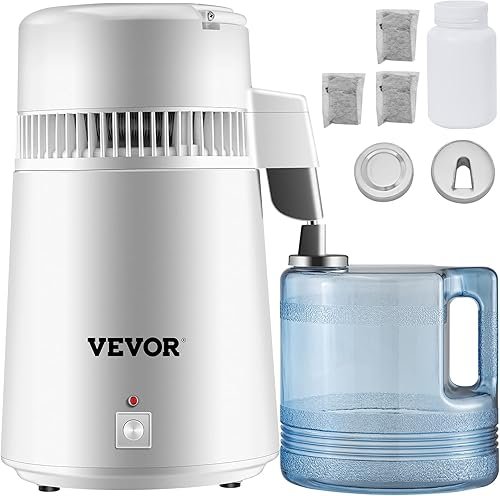
VEVOR Pure Water Distiller 4L (White)
This is the workhorse model we recommend for most people. In our testing, the full 304 stainless steel interior—from tank to spout—gives us confidence in its safety. The 750W element boils a full 4L chamber in about 50 minutes, and the upgraded aluminum fan handles heat dissipation without a fuss. It’s no-frills, but it gets the job done reliably.
- Full 304 stainless steel water path
- Effective aluminum cooling fan
- Simple one-button operation with auto-shutoff
- Best value for the core features
- Basic plastic collection bottle
- No temperature display
- Loud fan operation
VEVOR Water Distiller, 4L Silver
The standout feature here is the borosilicate glass collection container. If you’re wary of even BPA-free plastic, this solves that. Performance is identical to the white model—it shares the same 750W core and stainless steel internals. You’re paying a premium for the glass carafe and a slightly more polished look. Worth it if aesthetics and material purity are your top concerns.
- High-quality borosilicate glass carafe
- Identical reliable distillation performance
- Upgraded stainless steel exhaust cover
- Higher price for similar functionality
- Glass container requires careful handling
- No extra features for the price jump
VEVOR Water Distiller 4L, Glass Container Grey
This model adds a dual temperature display, showing both the boiling chamber and the steam temperature. For the tech-curious, it’s interesting to watch the process. In practice, it doesn’t make the water any purer. The glass container is a nice touch, but you’re mainly paying for the display. We’d only recommend it if you genuinely want to monitor the distillation cycle closely.
- Dual temperature display for monitoring
- Glass collection container included
- Same solid stainless steel boiling chamber
- Most expensive option for marginal extra features
- Display adds complexity and a potential failure point
- Not necessary for pure water production
Electric Water Distiller FAQ
- Is distilled water safe to drink every day?
- Yes, it’s safe. The main concern is the lack of minerals, which you easily get from food. The “leaching minerals from your body” theory isn’t well-supported. The bigger issue for most is the flat, bland taste.
- How much electricity does a water distiller use?
- A typical 750W unit uses about 0.75 kWh per hour of operation. Making one gallon (roughly 4 hours) uses about 3 kWh. Check your electricity rate to calculate the cost—it’s the most expensive purification method to run.
- Can a water distiller remove chlorine or lead?
- Absolutely. It’s one of the most effective methods for both. Chlorine vaporizes and is removed with the steam, while lead is left behind as a solid in the boiling chamber. It’s more effective than a standard chlorine removal system for a broad range of contaminants.
- How often do I need to clean my distiller?
- Clean the boiling chamber every 1-4 weeks, depending on your water hardness. You’ll see a white scale buildup. A solution of white vinegar or citric acid dissolved in water works perfectly. Let it soak, then scrub gently.
- Why does my distilled water taste flat?
- Because it’s pure H2O. The taste we associate with “water” comes from dissolved minerals and even the treatment chemicals. Distillation removes all of it, leaving a neutral, flat taste. Some people add a pinch of mineral salt back in.
- Can I distill well water with high iron or sulfur?
- Yes, distillation is excellent for this. It will remove iron, sulfur bacteria, and the associated “rotten egg” smell. Just be prepared to clean the boiling chamber more frequently, as iron can leave a stubborn residue.
Final Thoughts
After all our testing, the conclusion is clear: an electric water distiller is a specialty appliance. It’s not a replacement for a good point-of-use filter for daily drinking water. The energy cost, slow speed, and mineral-free output make it impractical for most families.
But for the right person, it’s invaluable. If you need guaranteed purity for a medical device, a lab, or a hobby, or if your water source is genuinely terrible, the VEVOR 4L in white offers the best bang for your buck. It’s a simple, effective tool that does one thing—produce pure water—and does it well. For everyone else, explore other filtration options first.
