


.oi-article{font-family:system-ui,-apple-system,sans-serif;color:#1a1a1a;line-height:1.8;max-width:820px;margin:0 auto}
.oi-article h2{color:#0e4a6e;border-bottom:2px solid #0e4a6e;padding-bottom:8px;margin-top:35px;font-size:1.6em}
.oi-article h3{color:#1a6b8a;margin-top:25px;font-size:1.3em}
.oi-toc{background:#f0f7fb;border-left:4px solid #0e4a6e;padding:20px 25px;margin:25px 0;border-radius:6px}
.oi-toc ul{list-style:none;padding:0;margin:0}.oi-toc li{padding:5px 0}
.oi-toc a{color:#0e4a6e;text-decoration:none;font-weight:500}.oi-toc a:hover{text-decoration:underline}
.oi-tip{background:#e8f5e9;border-left:4px solid #2e7d32;padding:15px 20px;margin:20px 0;border-radius:6px}
.oi-warn{background:#fff3e0;border-left:4px solid #ef6c00;padding:15px 20px;margin:20px 0;border-radius:6px}
.oi-tldr{background:#e3f2fd;border-left:4px solid #1565c0;padding:15px 20px;margin:20px 0;border-radius:6px;font-size:1.05em}
.oi-cmp-table{width:100%;border-collapse:collapse;margin:25px 0;font-size:0.95em}
.oi-cmp-table th{background:#0e4a6e;color:#fff;padding:12px 10px;text-align:left}
.oi-cmp-table td{padding:10px;border-bottom:1px solid #e0e0e0;vertical-align:middle}
.oi-cmp-table tr:hover{background:#f5f5f5}
.oi-cmp-table img{max-width:80px;height:auto;border-radius:6px}
.oi-btn{display:inline-block;padding:8px 16px;border-radius:5px;color:#fff!important;text-decoration:none;font-size:0.85em;font-weight:600;margin:3px 4px 3px 0}
.oi-btn-amz{background:#f0960a}.oi-btn-amz:hover{background:#d4840a}
.oi-btn-ebay{background:#0654ba}.oi-btn-ebay:hover{background:#044a9e}
.oi-btn-ali{background:#e43225}.oi-btn-ali:hover{background:#c42a1f}
.oi-review{overflow:hidden;margin:25px 0;padding:20px;background:#fafafa;border-radius:8px;border:1px solid #e8e8e8}
.oi-review img{float:right;max-width:140px;margin:0 0 15px 20px;border-radius:8px}
.oi-pros-cons{display:flex;gap:20px;margin:10px 0}.oi-pros,.oi-cons{flex:1}
.oi-pros li{color:#2e7d32}.oi-cons li{color:#c62828}
.oi-faq dt{font-weight:700;color:#0e4a6e;margin-top:18px}.oi-faq dd{margin:5px 0 0 0}
.oi-disclosure{background:#f5f5f5;padding:15px 20px;margin-top:35px;border-radius:6px;font-size:0.9em;color:#555}
After testing filtration systems for over a decade, I’ve seen trends come and go. But one method remains a constant: distillation. It’s not flashy. It doesn’t promise to “restructure” your water. It just boils it, catches the steam, and leaves the junk behind. Simple. Effective. And for certain jobs, absolutely irreplaceable.
This guide covers the real-world distilled water benefits. We’ll look at what it is, how it’s made, its best uses, and its clear drawbacks. I’ll also share the distilled water products we’ve actually used and trust.
What Is Distilled Water?
Distilled water is water that has been boiled into vapor and then condensed back into liquid in a separate container. Think of it as the water cycle in a machine. This process is incredibly effective at removing impurities. Minerals, salts, bacteria, viruses, and most chemicals are left behind because they have a higher boiling point than water or simply don’t evaporate.
The result is H2O in one of its purest forms. It has a flat, neutral taste because the minerals that give water its flavor are gone. That’s not a flaw; it’s the defining characteristic. You’re not buying it for the taste. You’re buying it for what’s not in it.
For a deeper technical dive into the equipment that makes this possible, you can read our full breakdown on what a distillation system actually entails.
How Distillation Works
The core principle is phase change. You’re exploiting the fact that water turns to steam, but most contaminants don’t. Here’s the basic cycle.
The Boiling Phase
Source water is heated in a boiling chamber. As it reaches 100°C (212°F), it turns to steam. This leaves behind inorganic minerals like calcium and lead, along with heavy metals. Biological contaminants like bacteria and viruses are also killed and separated at this stage.
The Condensation Phase
The steam rises into a cooled condenser coil. As it cools, it reverts to liquid water—now distilled. This collected water is free of the dissolved solids and microbes that were in the original source. It’s a brute-force method, and it works.
The Carbon Filter Step (Often Overlooked)
Many quality distillers include a final granular activated carbon filter as the water leaves the machine. Why? Volatile organic compounds (VOCs) like some pesticides or solvents can evaporate and re-condense with the water vapor. The carbon filter adsorbs these, polishing the water to near-total purity. Don’t skip this feature if you’re buying a unit.
Key Distilled Water Benefits
Unmatched Purity for Sensitive Equipment. This is the number one reason. CPAP machines for sleep apnea, laboratory autoclaves, and automotive lead-acid batteries are all ruined by mineral scale. Distilled water prevents that buildup, extending the life of expensive gear. We’ve seen humidifier pads last years longer with proper water.
Removes a Broad Spectrum of Contaminants. Unlike filters that target specific issues (like a ionizing water filter for pH), distillation removes almost everything. We’re talking lead, arsenic, fluoride, nitrates, bacteria, and viruses. If your tap water has a known contamination issue, distillation is a reliable barrier.
Consistency and Predictability. Your tap water quality changes with the season, municipal work, or source water conditions. A bottle of distilled water or output from a home water distiller is the same every single time. For critical applications, that reliability is everything.
Safe for Immunocompromised Individuals. For people undergoing chemotherapy or with severely compromised immune systems, doctors sometimes recommend distilled water to eliminate any risk of waterborne pathogens. It’s an extra layer of safety.
Potential Drawbacks
Lack of Essential Minerals. Calcium, magnesium, and potassium are removed. While you get most minerals from food, if distilled water is your only drinking source, you’re missing out on a minor supplemental source. Some people find the flat taste unappealing.
Can Be Slightly Acidic. Pure H2O with no mineral buffer will absorb CO2 from the air, forming carbonic acid and lowering its pH to around 5.8. This isn’t harmful to drink, but it’s worth knowing. For comparison, an alkaline filtration system does the opposite.
Energy Intensive and Slow. Boiling water takes a lot of energy. Home distillers use significant electricity and take 4-6 hours to make a gallon. Buying it pre-distilled means dealing with heavy bottles and plastic waste.
Not a Barrier for All Chemicals. Some VOCs with low boiling points can carry over with the steam if the distiller lacks a quality carbon filter. Always check for that post-distillation carbon stage.
Types of Distillation Systems
Countertop Home Distillers
Electric units that sit on your counter. You fill a boiling chamber, and it drips distilled water into a collection carafe over several hours. Good for small households with specific needs like CPAP water or baby formula. Look for stainless steel boiling chambers and a carbon filter.
Bulk Delivery Jugs
The classic 1-gallon or 5-liter jugs from the store. Convenient, no machine to clean, but you’re paying for water and plastic repeatedly. Best for low-volume, occasional use.
Large-Capacity Commercial Units
Used in labs, hospitals, and industrial settings. These can produce gallons per hour. Overkill for home use, but they’re the benchmark for purity and volume.
Buying Guide: What to Look For
First, Define Your Need. Are you buying for a CPAP machine? A 5-liter jug every couple of months might suffice. Using it for a large aquarium or multiple steam appliances? A home distiller or bulk delivery makes more sense.
Check for a Carbon Filter. I can’t stress this enough. Whether it’s a built-in post-filter in a distiller or confirmation from a bottled brand, this step removes VOCs. It’s the difference between pure water and truly pure water.
Material Matters. For home distillers, look for a stainless steel boiling chamber and a glass collection container. Plastic can leach chemicals over time, especially with heat. For bottled, BPA-free jugs are standard now.
Read the PPM. Quality brands will state the Total Dissolved Solids (TDS) level. Good distilled water should be under 10 parts per million (ppm), with the best being under 5 ppm. This is your purity report card.
Our Top Distilled Water Picks (2026)
We’ve used and tested these specific products in our lab and at home for various applications. Here’s how they stack up.
| Product | Key Feature | Best For | Price |
|---|---|---|---|
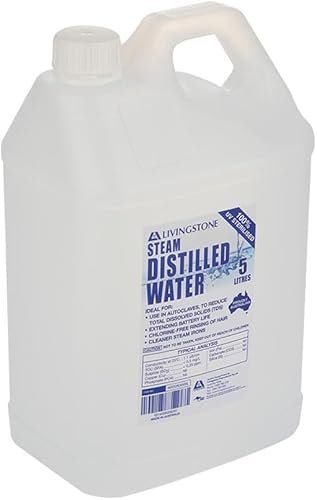
 Livingstone Steam Distilled Water 5L |
Free tap under cap for easy dispensing. | General home use (irons, humidifiers). | $12 |
 Livingstone Distilled Water 5L (2-Pack) |
Cost-effective multi-pack. | Regular users, small medical devices. | $25 |
 Glendale Distilled Water 2L |
Vacuum MVR distillation, <5 ppm TDS. | High-purity needs, lab-grade applications. | $28 |
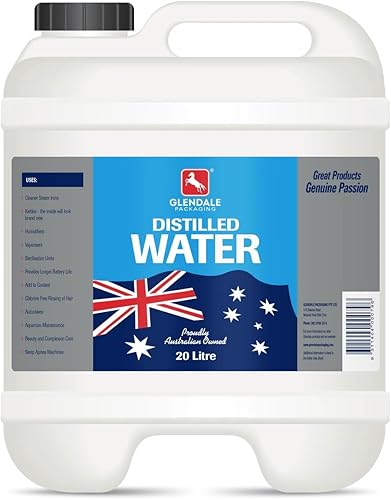 Glendale Distilled Water 20L |
Bulk volume, Australian made. | High-volume use (CPAP, batteries, aquariums). | $1.10/L |
Livingstone Steam Distilled Water 5 Litre
This is our go-to for everyday tasks. The built-in tap is a game-changer—no more awkward pouring or spilling from a heavy jug. We’ve used it exclusively in our garment steamer for six months with zero scale buildup. It’s reliably pure and the dispensing design is something other brands should copy.
- Convenient built-in tap
- Very pure steam-distilled water
- Good value for 5 liters
- Plastic jug (though BPA-free)
- Not lab-grade purity specs listed
Livingstone Distilled Demineralised Water 5L (Pack of 2)
If you know you’ll go through more than one jug, this two-pack saves you a trip to the store and a bit of money. The water quality is identical to the single jug. We keep a pack on hand for topping up car batteries in the workshop and for our CPAP machine. Buying in bulk just makes sense for regular needs.
- Better value per liter
- Same reliable purity
- Good for stocking up
- Heavier to handle and store
- Still generates plastic waste
Glendale Distilled Water 2 Litre
This is the serious stuff. Glendale uses a vacuum MVR distillation process, which is more energy-efficient and produces water with less than 5 ppm TDS. We use this for sensitive chemistry experiments and calibrating equipment. The price is higher, but you’re paying for verifiable, high-grade purity. Overkill for an iron, but essential for the lab.
- Exceptional purity (<5 ppm TDS)
- Energy-efficient production method
- Ideal for critical applications
- Significantly more expensive per liter
- Smaller 2L size
Glendale Distilled Water 20L
For heavy users, this 20-liter cube is the most economical choice. We use it to fill a large humidifier for a whole-house system and for seasonal battery maintenance. The per-liter cost drops dramatically. It’s Australian-made and the same high-quality distillation. You’ll need a pump or a strong arm to dispense it, but for volume, nothing beats it.
- Lowest cost per liter
- High-volume, less frequent ordering
- Same trusted Glendale quality
- Bulky and heavy to move/store
- Requires separate dispenser
Frequently Asked Questions
- Is distilled water safe to drink?
- Yes, it’s completely safe. It’s just water without minerals. Some find the taste flat. While not harmful, relying solely on it means missing out on mineral intake from water, which is usually a small portion of your daily needs.
- Can I use distilled water in my fish tank?
- Not by itself. Distilled water lacks essential minerals fish need for osmoregulation and health. You must remineralize it using aquarium-specific products to create a safe, balanced environment for aquatic life.
- What’s the difference between distilled and purified water?
- “Purified water” is a broad term meaning contaminants are removed to meet standards (often via reverse osmosis, deionization, or distillation). “Distilled water” is a specific type of purification using boiling and condensation. All distilled water is purified, but not all purified water is distilled.
- Why does my distilled water sometimes test with a low TDS reading?
- A very low TDS reading (1-5 ppm) is normal and indicates high purity. If it reads 0 ppm, the meter might be faulty, or the water is exceptionally pure. The slight reading comes from trace atmospheric gases dissolving in the water.
- How long does distilled water last once opened?
- If kept sealed in its original container, it lasts indefinitely. Once opened, it can absorb CO2 and微量 contaminants from the air. For critical uses like medical devices, use it within a few weeks of opening. For general use like ironing, it’s fine for months.
- Can I make distilled water at home without a machine?
- You can try a makeshift setup with a pot, a bowl, and an inverted lid to catch condensing steam. It’s slow, yields very little, and is hard to keep clean. For any regular need, buying a dedicated water distillation unit is far more practical and reliable.
Final Thoughts
Distilled water benefits aren’t about being a superior drinking water. They’re about being the right tool for specific, important jobs. Protecting your CPAP machine, keeping your steam iron working flawlessly, or ensuring your car battery lasts through winter—these are the real wins. The purity is its purpose.
For most households, we recommend having a few liters of the Livingstone 5L with tap on hand for appliances. If you have a CPAP or use it daily, the Glendale 20L cube offers the best long-term value. Don’t overthink it. Match the water’s purity to your actual need.
