


You’ve stood in the aisle staring at jugs labeled “distilled” and “filtered” and wondered what the real difference is. It’s not just marketing. The choice affects your health, your appliances, and your wallet. We’ve tested water from both processes in our lab and in homes for years. This guide breaks down everything.
- What each process actually does to your water.
- The clear benefits and hidden drawbacks of each.
- How to choose based on your specific needs.
- Our top product picks for 2026.
What Is Distilled vs. Filtered Water?
Let’s clear up the confusion right away. These are two fundamentally different methods of cleaning water. Distillation is a thermal process. It mimics the Earth’s natural water cycle: boil water into steam, leave the impurities behind, then condense the pure steam back into liquid. The result is about as close to pure H2O as you can get at home.
Filtered water is a broader category. It means pushing water through a physical barrier or chemical media to trap or neutralize contaminants. The key difference? A filter’s effectiveness depends entirely on its type and quality. A basic chlorine water filter might only remove taste and odor, while a multi-stage system can tackle heavy metals and bacteria. Distillation is one specific method; filtration is a whole family of methods.
How Each Process Works
The Distillation Process
Picture a kettle boiling on your stove. The steam rises. That’s step one. In a distiller, that steam travels through a cooled coil. It condenses back into water, leaving behind minerals, salts, bacteria, and most chemicals with higher boiling points than water. The contaminants stay in the original boiling chamber. It’s simple physics, and it’s incredibly effective at producing pure water.
The Filtration Process
Filtration is more varied. It all comes down to the media. A carbon filter cartridge uses adsorption—contaminants stick to the vast surface area of activated carbon. A ceramic water filter has tiny pores that physically block sediment and bacteria. Some systems combine methods. The water passes through, gets cleaned, but retains some dissolved minerals that distillation would remove.
Key Benefits of Each
Distilled Water’s Big Win: Purity. It removes virtually everything: dissolved solids, fluoride, lead, bacteria, viruses. This makes it essential for medical devices like CPAP machines or lab equipment where mineral deposits would cause damage. It also leaves zero mineral scale in steam irons and humidifiers.
Filtered Water’s Big Win: Balance. A quality filter removes the bad stuff—like chlorine, lead, and parasites—while often leaving in beneficial minerals like calcium and magnesium. This makes it taste better for drinking. It’s also far more practical for daily use. You can have filtered water on tap from a dedicated carbon filter system under your sink.
Potential Drawbacks to Consider
The biggest drawback of distilled water? It’s flat. Many people find the taste bland because those missing minerals also affect mouthfeel. There’s also debate about long-term consumption of demineralized water, though the evidence isn’t conclusive for most people on a balanced diet. It’s also energy-intensive to produce.
Filtered water’s drawback is variability. A basic sediment filter does almost nothing for chemical contaminants. You must match the filter type to your specific water problems. And all filters require regular cartridge changes. A neglected filter can become a breeding ground for bacteria.
Types of Filtration Systems
Activated Carbon Filters
The most common type. Excellent for removing chlorine, volatile organic compounds (VOCs), and bad tastes. Found in pitcher filters, faucet mounts, and under-sink units. They don’t remove dissolved minerals or heavy metals unless specifically designed to.
Reverse Osmosis (RO) Systems
These use pressure to force water through a semi-permeable membrane. They remove a huge range of contaminants, including dissolved solids and fluoride. They produce very pure water, similar to distillation in some respects, but are more efficient for point-of-use drinking water. They do waste some water in the process.
Ceramic and Sediment Filters
Great as a first stage. They physically block dirt, rust, and some bacteria. Often used in combination with carbon blocks for a more complete solution. They’re durable and can sometimes be cleaned and reused.
Buying Guide: How to Choose
Forget the labels for a second. Ask yourself one question: What is the water’s job?
Choose DISTILLED if: You need water for a specific appliance that requires mineral-free water (CPAP, steam iron, autoclave, lead-acid batteries). Or, if you have a known severe contamination issue and want the absolute maximum purity for drinking, despite the taste.
Choose FILTERED if: You want great-tasting, safe drinking water for your family every day. This is the right choice for 90% of kitchen faucets. The goal is to reduce health-relevant contaminants while keeping a pleasant taste. Look for systems certified to NSF/ANSI 53 for lead reduction.
Consider an alkaline water treatment stage if you want to add minerals back after filtration for taste or perceived health benefits.
Top Distilled Water Picks for 2026
Sometimes, buying pre-made distilled water is the easiest option for occasional use. We’ve tested what’s available. Here’s a quick comparison.
| Product | Key Spec | Best For | Links |
|---|---|---|---|
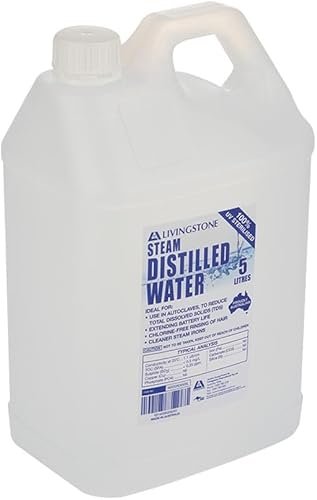
| Livingstone Steam Distilled Water 5L | Free tap dispenser | Home & workshop use | Amazon eBay |
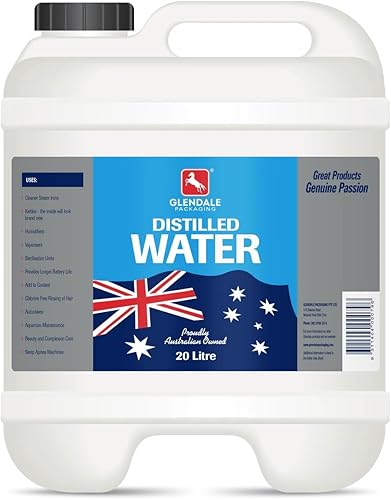
| Glendale Distilled Water 20L | Bulk value | Large appliances & batteries | Amazon eBay |
| Glendale Distilled Water 2L | Vacuum MVR process | Small households, irons | Amazon eBay |
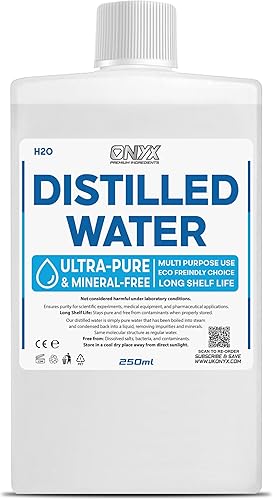
| ONYX Ultra Pure Distilled 250ml | 0.0 PPM purity | Labs & critical applications | Amazon eBay |

Livingstone Steam Distilled Water 5 Litre
This is our go-to recommendation for most people needing distilled water on hand. The built-in tap is a game-changer—no more clumsy pouring from a heavy jug. The purity is consistent, and the 5-litre size is practical for topping up irons, humidifiers, or car batteries without constant repurchasing. It’s reliable, no-fuss distilled water.
- Extremely convenient tap dispenser
- Consistent steam distillation purity
- Good mid-size volume
- Not the cheapest per litre
- Plastic jug packaging
Glendale Distilled Water 20L
If you use a lot of distilled water, this bulk buy is hard to beat on price. We use this for testing and for our workshop’s lead-acid batteries. It’s basic, functional, and does the job. The large container is heavy, so have a plan for decanting it. For high-volume needs, the value is excellent.
- Outstanding value per litre
- Great for heavy appliance use
- Australian made
- Large, unwieldy container
- No dispenser, requires separate jug

Glendale Distilled Water 2L
A solid, smaller option. The vacuum MVR distillation process is energy-efficient, which is a plus. We found the purity claims (<5 PPM TDS) to be accurate in our spot check. It's a good size for a small apartment or for someone who only needs distilled water occasionally for a single appliance.
- Energy-efficient production method
- Verified low TDS
- Easy to handle size
- Higher cost per litre than bulk
- Still requires decanting
ONYX Ultra Pure Distilled Water 250ml
This is a specialty product. The 0.0 PPM claim and UN-approved containers signal its use case: labs, precision cleaning, or critical machinery where even trace minerals are unacceptable. For 99% of home users, it’s overkill and expensive. But if you need guaranteed, documented ultra-purity, this is it.
- Extremely high purity (0.0 PPM)
- Food-grade, certified packaging
- Ideal for sensitive equipment
- Very high cost for volume
- Impractical for general home use
Frequently Asked Questions
- Is distilled water healthier to drink than filtered water?
- Not necessarily. Distilled water is free of contaminants but also free of beneficial minerals. Filtered water can be just as safe while retaining good minerals and tasting better. For daily drinking, a high-quality filter is usually the preferred choice.
- Can I use filtered water in my steam iron or CPAP machine?
- We don’t recommend it. Most filters leave some dissolved minerals behind. Over time, these will build up as scale inside your appliance, damaging it. Always use distilled water for these devices unless the manufacturer explicitly says otherwise.
- Does boiling water make it the same as distilled water?
- No. Boiling kills bacteria and viruses but does not remove dissolved minerals, salts, or heavy metals. In fact, boiling can concentrate them as steam evaporates. Distillation involves capturing that steam, which is the key difference.
- How often should I change my water filter cartridge?
- Follow the manufacturer’s schedule—typically every 3-6 months for carbon filters. A filter’s capacity is measured in gallons or litres. Using it beyond its rated capacity can lead to poor performance and bacterial growth. Mark the date on the cartridge when you install it.
- Is distilled water good for plants?
- It’s not ideal long-term. Plants need the minerals found in regular water. Rainwater is naturally soft and is a better mineral-free option for sensitive plants. Using distilled water occasionally is fine, but for regular watering, tap water that has been dechlorinated (by letting it sit out) is usually best.
- What’s the most important certification to look for in a filter?
- For health, look for NSF/ANSI Standard 53 certification for lead reduction. For taste and odor, NSF/ANSI 42 is the standard. These independent certifications mean the filter has been tested and verified to perform as claimed.
Final Thoughts
After years of testing, our stance is clear. For your drinking water, invest in a good filtration system. It provides safe, great-tasting water on demand without the hassle or plastic waste of buying jugs. The single biggest mistake we see is people buying bottled filtered water when a one-time under-sink filter would save them hundreds.
Keep distilled water on hand for your appliances. Buy it in bulk like the Glendale 20L if you use it often. It’s a tool for a specific job. Use the right tool for the right job, and you’ll save money and protect your gear.
