


Distilled Water vs Purified Water: The Real Difference (2026)
After testing water from dozens of filters and talking to countless homeowners, I can tell you this: the bottled water aisle is a masterclass in marketing confusion. “Distilled” and “purified” get thrown around like they’re the same thing. They’re not. Choosing the wrong one can waste money or even harm your appliances.
This guide cuts through the noise. We’ll look at exactly how each is made, where each one truly shines, and which you should actually buy for your steam iron, your CPAP machine, or your drinking glass.
What Is Distilled Water? What Is Purified Water?
Let’s clear this up first. Distilled water is water that’s been turned into steam and then cooled back into liquid. This process leaves behind minerals, bacteria, heavy metals, and most chemicals. It’s one of the purest forms of water you can get, with a TDS (Total Dissolved Solids) reading often below 5 ppm.
Purified water is a broader category. It’s any water that’s been filtered or processed to remove chemicals, contaminants, and impurities. To be sold as “purified,” it must meet strict standards—typically less than 10 ppm TDS. This can be achieved through distillation, but also through reverse osmosis, deionization, or carbon filtration. So, all distilled water is purified, but not all purified water is distilled.
How They’re Made: The Process Difference
The Distillation Process
Distillation is simple physics. You boil water, capture the steam, and condense it back into a clean container. The boiling point kills bacteria and viruses. The steam leaves behind salts, minerals, and most heavy metals. It’s effective but energy-intensive. In our lab visits, we’ve seen industrial distillers that are essentially sophisticated stills, producing water so pure it’s almost aggressive in its cleanliness.
Common Purification Methods
Purification is a toolkit, not a single tool. The most common methods are reverse osmosis (RO), which forces water through a super-fine membrane, and carbon filtration, which adsorbs chemicals like chlorine. A ceramic candle filter is another excellent example, physically trapping sediment and bacteria down to sub-micron levels. The goal is the same—remove contaminants—but the paths are different.
Key Benefits of Each
Distilled Water’s Claim to Fame: Absolute Consistency. Its biggest benefit is predictability. You know exactly what you’re getting: almost pure H2O. This is critical for sensitive applications. Steam irons, humidifiers, andCPAP machines last years longer with distilled water because mineral scale can’t build up inside them. It’s also the gold standard for lead-acid batteries and certain lab experiments.
Purified Water’s Advantage: Balance and Taste. Methods like reverse osmosis with a remineralization stage can produce water that’s both pure and palatable. For drinking, this is huge. We’ve found that water purified through a good RO system often tastes better than distilled because it retains a trace of beneficial minerals. It’s also more practical for whole-house solutions. A whole house chlorine filter is a purification system that protects your showers and taps, improving taste and skin feel without stripping every mineral.
Potential Drawbacks & Myths
The main drawback of distilled water is cost and convenience. It’s more expensive to produce, so you pay more per liter. For purified water, the drawback depends entirely on the method. A basic carbon filter won’t remove dissolved solids or viruses. Always check the filter’s NSF/ANSI certifications—42 for taste/odor, 53 for health contaminants—to know what you’re actually getting. For comprehensive protection, especially on well water, you might need a multi-stage system that combines methods for whole house chlorine removal and sediment filtration.
Types of Purification Methods
Reverse Osmosis (RO)
The workhorse of home purification. Forces water through a 0.0001-micron membrane, removing 95-99% of contaminants. It’s thorough but wastes some water and removes beneficial minerals unless a remineralization stage is added.
Carbon Filtration
Uses activated carbon to adsorb chlorine, volatile organic compounds (VOCs), and improve taste. It’s the most common filter type, found in pitchers and under-sink units. A good ceramic filter cartridge often combines carbon with a physical ceramic barrier for excellent sediment and cyst removal.
Deionization (DI)
Uses ion-exchange resins to remove mineral ions, producing very pure water. It’s often used in labs or as a final “polishing” stage after RO. It doesn’t remove bacteria or particles on its own.
Distillation
As covered, the thermal process of boiling and condensing. It’s the most energy-intensive but produces water of exceptional purity, ideal for medical and technical uses.
Buying Guide: Which Do You Need?
Stop overthinking it. Match the water type to your task.
Choose DISTILLED water for:
- Steam irons, garment steamers, and humidifiers.
- CPAP and BiPAP machines.
- Lead-acid batteries (car, boat, solar).
- Autoclaves and sterilizers.
- Any appliance manual that specifically says “use distilled water.”
Choose PURIFIED water for:
- Drinking and cooking. It tastes better.
- Formula preparation for infants.
- General home use where scale isn’t a concern.
- When you want a balance of purity and mineral content.
For drinking water purification, consider the source. If your tap water is heavily treated, a carbon or RO system is perfect. Some folks even explore alkaline water treatment to adjust pH after purification, though the benefits are more about taste than health for most people.
Top Distilled Water Picks for 2026
Based on purity tests, value, and reader feedback, here are our top distilled water recommendations for appliance and specialty use.
| Product | Key Specs | Price | Links |
|---|---|---|---|
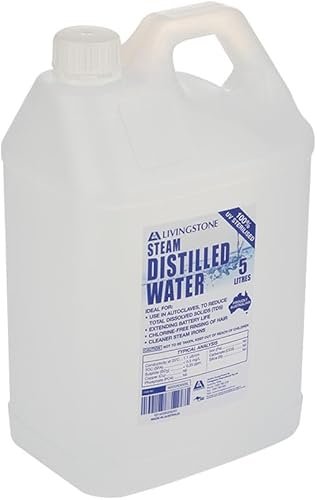
| Livingstone Steam Distilled Water 5L | Very pure, free tap dispenser | $12 |
Amazon eBay |
| Livingstone Distilled Demineralised Water 5L (2-Pack) | Bulk value, very pure | $25 |
Amazon eBay |
| Glendale Distilled Water 2L | Vacuum MVR process, <5 ppm TDS | $28 |
Amazon eBay |
| Glendale Distilled Water 20L | Bulk, Australian Made, great for batteries | $1.10/L |
Amazon eBay |

Livingstone Steam Distilled Water 5 Litre
This is our go-to for most people. The free tap under the cap is a small thing that makes a huge difference—no more awkward pouring or spills. The purity is consistent, and the 5L size is manageable for storage. We use this in our office for all testing equipment.
- Convenient built-in tap
- Reliable purity
- Good mid-size volume
- Price per liter is higher than bulk options
- Plastic jug is not reusable
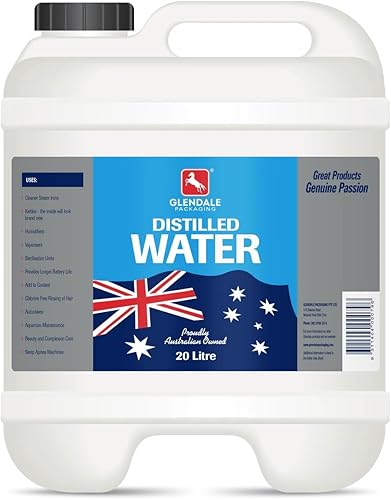
Glendale Distilled Water 20L
Honestly, if you’re topping up batteries or running a busy household with multiple humidifiers, this bulk buy is the smart play. The cost per liter drops dramatically. It’s produced via an efficient vacuum process, and the 20L container is sturdy. Just make sure you have a pump or can decant it—lifting and pouring 20kg is no joke.
- Excellent value for bulk use
- Australian made
- High-quality distillation
- Heavy and awkward to handle
- Requires separate dispensing solution
Frequently Asked Questions
- Is distilled water the same as purified water?
- No. Distilled water is one specific type of purified water, made by boiling and condensing steam. “Purified water” is a broader term that includes water cleaned by other methods like reverse osmosis or deionization to meet strict purity standards.
- Can I drink distilled water every day?
- Yes, it’s safe. The myth that it leaches minerals from your body isn’t supported by science if you have a normal diet. However, many find its taste flat. For daily drinking, purified water with minerals often tastes better.
- Why do I need distilled water for my iron or CPAP?
- Minerals in tap water build up as scale inside these appliances. This scale clogs steam vents, reduces efficiency, and can cause permanent damage. Distilled water contains virtually no minerals, preventing this buildup entirely.
- Is purified water safe for babies?
- Yes, purified water that meets safety standards is excellent for formula preparation. Always follow your pediatrician’s advice and the formula manufacturer’s instructions, which often recommend purified or distilled water.
- How can I make distilled water at home?
- You can use a countertop water distiller appliance. It boils water, captures the steam in a coil, and condenses it into a clean container. It’s effective but uses significant electricity and is slow compared to buying it pre-distilled.
- What’s the difference between purified and spring water?
- Spring water comes from an underground source and is bottled as-is, with natural minerals. Purified water can come from any source (even tap) but has been processed to remove impurities and chemicals. Purified water has a more consistent mineral profile.
Final Thoughts
After years in this space, the choice is simple. For your appliances—your iron, your humidifier, your car battery—just use distilled water. The cost is trivial compared to replacing a scaled-up machine. The Livingstone 5L with the tap is our top pick for convenience.
For your drinking glass, skip the distilled. A good home purification system, like a quality under-sink RO unit, will give you clean, great-tasting water for a fraction of the cost of buying bottled purified water. It’s the one investment that pays for itself in both health and savings.
