


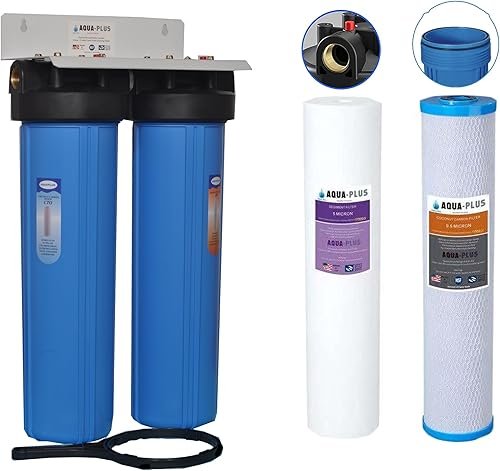
Whole House Carbon Filtration: The 2026 Homeowner’s Guide
You’ve probably thought about it every time you fill a glass or step into the shower. That slight chemical taste, the dry skin, the fading on your new towels. The water coming into your home isn’t just for drinking—it’s for everything. And a point-of-use filter under the kitchen sink only solves part of the problem.
That’s where whole house carbon filtration steps in. We’ve installed, tested, and lived with these systems for years. This guide cuts through the marketing fluff to show you what actually works, what to look for, and which systems we’d trust in our own homes.
- What whole house carbon filtration is and how it differs from a simple faucet filter.
- The real science behind how activated carbon cleans your water.
- Key benefits you’ll notice and honest drawbacks to consider.
- A breakdown of system types and our top product picks for 2026.
What Is Whole House Carbon Filtration?
Think of it as a gatekeeper for your entire home’s water supply. Installed where the main water line enters your house—usually in the garage, basement, or a utility closet—this system forces all incoming water through one or more carbon filter cartridges before it branches off to any tap, appliance, or showerhead.
It’s a fundamentally different beast than the small pitcher in your fridge or the filter on your kitchen faucet. Those are point-of-use solutions. A whole house system is a point-of-entry solution. Its job is to treat water for washing, bathing, and laundry—not just drinking. The primary target is chlorine, chloramine, volatile organic compounds (VOCs), and the bad taste and odor they cause.
What it typically doesn’t do is remove dissolved minerals (like calcium for hardness), heavy metals (like lead or copper), or microorganisms. For that, you’d need a more advanced setup, often combining your alkaline filtration system or a dedicated sediment stage. But for the vast majority of folks on municipal, chlorinated water, it’s the single most impactful upgrade for daily water quality.
How Whole House Carbon Filtration Works
The Magic of Adsorption
This isn’t a simple screen that catches particles. Carbon filtration relies on adsorption—a process where contaminants are chemically bonded to the surface of the carbon media. Picture a magnet for certain chemicals. Activated carbon is incredibly porous; a single gram has the surface area of a football field. All those nooks and crannies trap chlorine molecules and organic compounds as water flows past.
Carbon Types: Block vs. Granular
You’ll mainly see two forms. Carbon blocks are solid, compressed filters. They offer finer filtration (down to 0.5 or 1 micron) and are great for sediment and chlorine. Granular Activated Carbon (GAC) looks like tiny black beads. It often has a higher flow rate and can be better for higher volumes of chemical reduction. For a deep dive, our guide on the granular activated carbon filter breaks down the pros and cons. Many whole house systems use a combination: a sediment pre-filter, then a carbon block or GAC stage.
The Critical Role of Contact Time
Here’s a detail most people miss. For adsorption to work, water needs enough contact time with the carbon. This is why filter size matters immensely. A small, 10-inch cartridge might not hold enough media to treat high flow rates effectively, letting some chlorine slip through. Larger 20-inch “Big Blue” housings provide more media and longer contact time, which is why they’re the standard for whole house applications. The quality of the activated carbon water filter media itself—its source (coconut shell is often superior) and activation process—directly impacts its adsorption capacity and lifespan.
Key Benefits of a Whole House System
Chlorine-Free Showering and Bathing. This is the benefit you’ll feel immediately. Chlorine vaporizes in hot water, and you inhale it and absorb it through your skin. Removing it at the source means softer skin, less hair dryness, and no more chlorine gas in your steamy shower. Based on reader feedback, this is the number one reason people make the switch.
Protects Appliances and Plumbing. Chlorine and sediment are brutal on washing machines, dishwashers, water heaters, and even toilet valves. A whole house system acts as a first line of defense, extending the life of these expensive appliances. We’ve seen the gunk that builds up in an unfiltered water heater—it’s not pretty.
Cleaner Water from Every Tap. No more separate filters for the kitchen, the bathroom, or the fridge. The water for brushing your teeth, cooking pasta, and filling the dog’s bowl is all filtered. It simplifies your life and ensures consistent quality throughout the home.
Potential Drawbacks & Limitations
Won’t Remove “Dissolved” Stuff. If your water is hard (causes scale), carbon won’t touch the calcium and magnesium. It also does nothing for fluoride, nitrates, or dissolved heavy metals like lead. For lead removal, you need a filter certified to NSF/ANSI Standard 53—and most whole house carbon filters are not. You might need a dedicated under-sink filter for drinking water if lead is a concern.
Filter Replacement is Non-Negotiable. A saturated carbon filter stops working. Worse, it can become a breeding ground for bacteria and start dumping trapped contaminants back into your water. You must change cartridges on schedule, typically every 6-12 months depending on your water quality and usage. Skipping this turns your investment into a liability.
Can Affect Water Pressure. Any filter adds restriction. If you have low water pressure to begin with, or a very large home with multiple bathrooms running at once, you need to size your system correctly. Opt for larger housings and high-flow cartridges to minimize pressure drop. In our testing, a poorly sized system can cut pressure noticeably when two showers run simultaneously.
Types of Whole House Carbon Systems
Standard Cartridge-Based Systems
This is what most homeowners install. It consists of one or more filter housings (usually blue “Big Blue” 10″ or 20″ size) mounted on a bracket. You replace the internal cartridge (sediment, carbon block, GAC) periodically. They’re affordable, versatile, and easy to maintain. The systems below are all this type.
Backwashing Carbon Tanks
For homes with very high water usage or high levels of contaminants, a large tank filled with pounds of granular carbon is the way to go. These systems automatically backwash—flushing the media to clean it—which extends the media life to 5-10 years. They have a higher upfront cost and need a drain for the backwash cycle, but they offer superior contact time and lower long-term maintenance. This is professional-grade territory.
Hybrid Systems
Many modern setups combine carbon filtration with other media. A common and effective combo is a sediment pre-filter, a carbon block for chlorine, and a third stage with a specialized media like KDF for heavy metal reduction or a polyphosphate scale inhibitor. These offer a more complete solution in a single package.
Buying Guide: What Actually Matters
1. Size & Flow Rate: Ignore the “for X bathrooms” marketing. Look at the flow rate in gallons per minute (GPM). A small 10″x2.5″ system might only handle 5-7 GPM. A 20″x4.5″ system can handle 15-25 GPM. For a typical 3-bathroom home, aim for at least 10-15 GPM to avoid pressure drops.
2. Filter Stages & Order: A proper sequence is key. Stage 1 should always be a sediment filter (5 micron is a good balance) to protect the carbon from clogging. Stage 2 is your main carbon block or GAC filter. A third stage is optional for finer polishing. Don’t put carbon first—it will clog fast.
3. Certifications: Look for NSF/ANSI Standard 42 certification for aesthetic effects (chlorine, taste, odor). Some filters may also carry Standard 53 for health effects (like cyst reduction). This is your guarantee of performance claims.
4. Replacement Cost & Frequency: Calculate the annual cost of cartridges. A cheap system with expensive proprietary filters is no bargain. Standard-sized cartridges (like 20″x4.5″) give you more brand choice and competitive pricing.
Our Top Picks for 2026
| Product | Key Specs | Price | Links |
|---|---|---|---|
| Aqua-Plus 2 Stage Jumbo Big Blue | 20″x4.5″ Housings, 1″ Ports, Sediment + Carbon Block | $1.92 |
Amazon eBay |
| Twin Whole House 2-Stage System | 10″x2.5″ Housings, Brass Ports, Claims 99.99% Chlorine Removal | $99 |
Amazon eBay |
| Geekpure 2 Stage 10″ System | 10″x4.5″ Housings, 1″ NPT Brass Ports, Includes Wrench | $1.75 |
Amazon eBay |
| Sediment & Double Coconut Carbon Block Cartridges | 10″x4.5″ Universal 3-Stage Replacement, 5-Micron Gradient | $89 |
Amazon eBay |
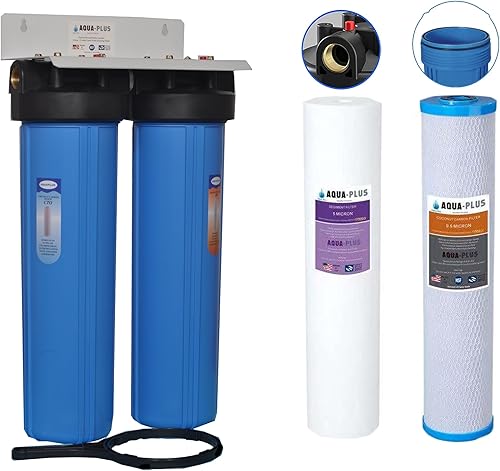
1. Aqua-Plus 2 Stage Jumbo Big Blue
This is a solid, no-frills workhorse. The 20″x4.5″ housings are the gold standard for flow rate and capacity. We like the included pressure release button—makes cartridge changes less of a splash zone. The 5-micron sediment filter is a good starting point. At this price for the housing kit, it’s an incredible entry point if you’re willing to source your own quality cartridges. The listed price seems to be for the housings only, so factor in the cost of filters.
- Standard large housings for great flow
- Pressure release valve is a nice touch
- Extremely low upfront cost for the manifold
- Price likely for housings only, cartridges extra
- Basic sediment filter, you may want to upgrade
- Need to verify included O-rings and wrench
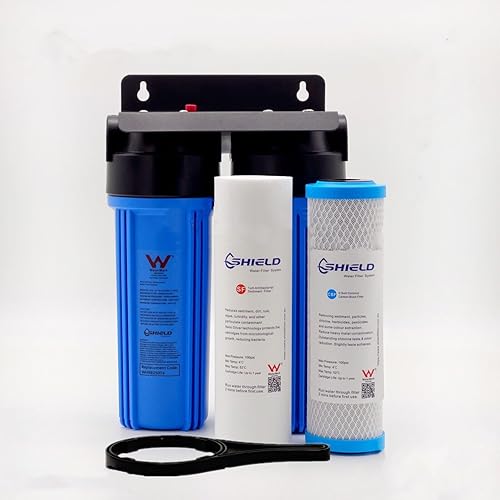
2. Twin Whole House 2-Stage System
A complete, ready-to-install package at a mid-range price. The 10″x2.5″ size is better suited for smaller homes or apartments with lower flow demands. The claim of 99.99% chlorine removal is bold—typical for a quality carbon block, but real-world performance depends on flow rate and contact time. The inclusion of “watermark” housings suggests a focus on durability. This is a good all-in-one solution if you don’t want to hunt for separate parts.
- Complete system with cartridges included
- Brass ports for durability
- Marketed for appliance protection
- Smaller 10″ size limits peak flow rate
- Higher price than just buying housings
- Chlorine claim needs real-world verification
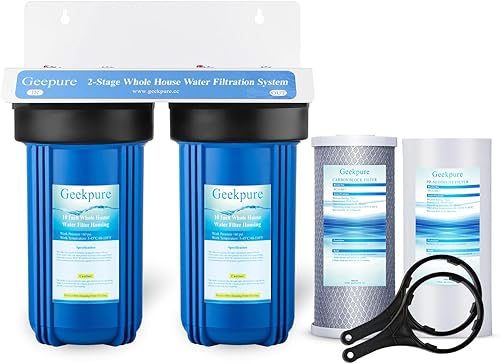
3. Geekpure 2 Stage 10″ System
Similar story to the first Aqua-Plus but in a smaller 10″x4.5″ format. The inclusion of a wrench and mounting screws is helpful. The 1″ NPT brass ports are standard. This is a bare-bones kit for the DIYer. The 10″ size means lower upfront cost and cheaper replacement cartridges, but also a lower maximum flow rate. Good for a condo or a home with 1-2 bathrooms where peak demand isn’t huge.
- Very affordable entry point
- Includes wrench and hardware
- 4.5″ diameter allows better flow than 2.5″
- 10″ cartridges have less capacity than 20″
- Will need more frequent changes in high-use homes
- Cartridges not included in base price
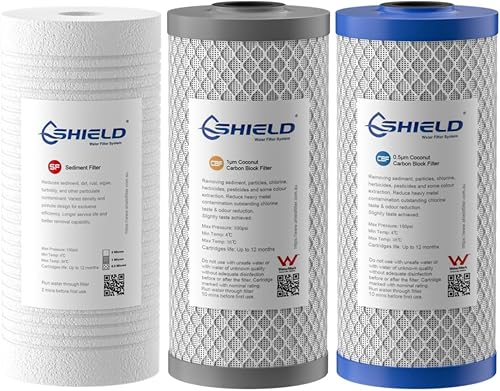
4. Sediment & Double Coconut Carbon Block Cartridges
These aren’t a system, but the heart of one. If you already have a 10″x4.5″ housing, this 3-stage replacement set is intriguing. The gradient-density sediment filter is a smart design—it catches both large and fine particles without clogging instantly. The “double coconut carbon block” suggests high-quality media for chlorine and VOC reduction. At $89 for three filters, it’s a competitive price for maintenance. A great way to upgrade an existing system.
- High-quality coconut shell carbon
- Smart gradient sediment filter design
- Cost-effective 3-pack for replacements
- Requires an existing 3-stage 10″x4.5″ housing
- Not a standalone system
- Need to verify actual performance claims
Frequently Asked Questions
- How often do I need to change whole house carbon filters?
- Typically every 6-12 months, or every 50,000-100,000 gallons. It depends on your water quality and usage. If you notice the chlorine taste or smell returning, it’s definitely time. A sediment pre-filter may need changing every 3-6 months.
- Will a whole house carbon filter soften my water?
- No. Carbon filters do not remove the dissolved calcium and magnesium minerals that cause hard water and scale. You need a water softener for that, which uses a different ion-exchange process. The two systems are often installed together.
- Can it remove lead from my drinking water?
- Most standard whole house carbon filters are not certified for lead removal. For lead, you need a filter specifically certified to NSF/ANSI Standard 53 for lead reduction, usually a dedicated under-sink system with a specialized carbon block or other media.
- What’s the difference between a carbon block and GAC filter?
- A carbon block is a solid, compressed filter that also provides sediment filtration down to a specific micron rating. GAC (Granular Activated Carbon) is loose media that offers excellent chemical adsorption and high flow rates but no sediment filtration. Many systems use both in sequence.
- Do I need a plumber to install one?
- If you’re comfortable with basic plumbing—shutting off your main water line, cutting into a pipe, and using thread sealant—you can install a cartridge-based system. Backwashing tank systems are more complex and often warrant a professional. Always check local codes.
- Can I use this with well water?
- You can, but it’s rarely enough on its own. Well water often has sediment, iron, bacteria, and other issues that require pre-treatment before the carbon stage. Always get a comprehensive well water test first and design a multi-stage system accordingly.
Final Thoughts
After testing systems for over a decade, we keep coming back to a simple truth: whole house carbon filtration is about improving your daily life, not achieving laboratory purity. It’s for the person who wants to step out of a shower without smelling like a swimming pool, who wants their morning coffee to taste like coffee, and who wants their washing machine to last another five years. It’s a practical, impactful upgrade.
Our clear recommendation for most homeowners is a 2-stage system with a 5-micron sediment filter followed by a 0.5-micron carbon block, housed in standard 20″x4.5″ Big Blue housings. It offers the best balance of flow rate, contaminant reduction, and manageable maintenance. The systems listed above give you a starting point—from bare housings to complete kits. Pair it with a quality alkaline water treatment stage at your kitchen sink if you want mineral-rich drinking water, and you’ve got a comprehensive home water solution that covers all the bases.
