


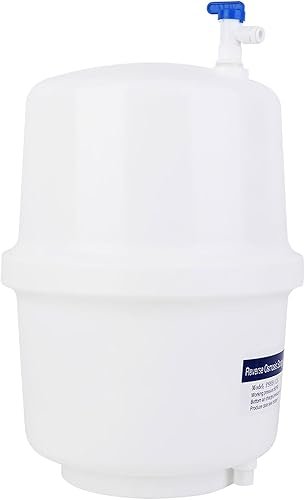
Your reverse osmosis system is working, but the water trickles out. Sound familiar? Before you blame the membrane, check the tank. After testing dozens of systems, I can tell you that incorrect ro tank pressure is the single most common cause of poor performance. It’s a simple fix most people overlook.
- What RO tank pressure actually is and why it matters
- How to check and adjust it in under 5 minutes
- The top signs your tank pressure is off
- Our top tank picks for reliability and value in 2026
What Is RO Tank Pressure?
Think of your RO tank as a balloon inside a rigid steel shell. The space between the balloon (a rubber diaphragm) and the outer shell is filled with air, pressurized like a bike tire. This is your ro tank pressure, or pre-charge. It’s not the water pressure from your main line; it’s a separate, contained air charge.
When your RO system makes water, it pushes purified water into the balloon, compressing the air on the other side. When you open the faucet, that compressed air squeezes the balloon, forcing the water out. No air pressure, no push. It’s that simple. This stored water is what you use for drinking and cooking, separate from the continuous flow you’d get from a standard in house water filter.
The factory setting is usually between 5 and 8 psi (pounds per square inch) when the tank is empty. This number is critical. Too low, and the water dribbles out. Too high, and the tank can’t fill properly, leaving you with very little reserve.
How RO Tank Pressure Works
The Fill Cycle
Your RO system’s automatic shut-off valve watches the pressure. When the tank pressure rises to about 2/3 of your feed water pressure (say, 40 psi on a 60 psi line), it tells the system to stop making water. The tank is “full.” But it’s only full because the air pre-charge is being compressed to that higher point.
The Draw Cycle
You turn on the faucet. The compressed air expands, pushing water out. As water leaves, pressure drops. Once it falls below a set point, the shut-off valve opens again, and the system starts producing more water to refill the tank. This cycle repeats constantly.
The Role of the Diaphragm
The rubber diaphragm is the barrier. It keeps the air and water separate. If it fails (a rare but possible event), the air charge can leak into the water, or water can fill the air side, causing a “waterlogged” tank. This is why the quality of the diaphragm material, like high-grade chlorobutyl, matters for longevity.
Key Benefits of Correct Tank Pressure
Strong, Immediate Flow: Proper pressure means a solid stream from the moment you open the tap. No waiting, no trickle. It feels like a real faucet, not a novelty.
Full Tank Capacity: Your 3.2-gallon tank will actually hold close to 3.2 gallons of usable water. With wrong pressure, you might only get 1 gallon before the flow dies. That’s a huge waste of capacity you paid for.
Extended System Life: The pump and membranes work less when the tank cycles correctly. Constant short-cycling from bad pressure wears components out faster. Getting this right is as important as choosing the right sediment pre filter to protect your system.
Consistent Water Quality: A properly pressurized tank reduces “TDS creep,” where higher-mineral water from the tank’s air side can slowly seep through the diaphragm when pressure is too low, slightly raising the TDS of your dispensed water.
Potential Drawbacks & Warning Signs
How do you know your ro tank pressure is off? The signs are pretty obvious once you know what to look for.
Low Pressure (Most Common): Water flows weakly or stops completely even though the tank feels heavy. You might get one good glass, then nothing. The tank never feels “rock solid” when full. This often happens after a few years as the air charge slowly permeates through the diaphragm.
High Pressure (Less Common): The system makes a lot of noise but the tank feels light and never seems to fill. You get very little water. This is usually from over-inflating during a check or a factory defect.
Waterlogged Tank: The tank feels incredibly heavy, almost solid, even when “empty.” No air comes out of the Schrader valve when you press it—just water. The diaphragm has failed. Time for a new tank. While you’re at it, consider if your water needs a salt water softener upstream to reduce mineral stress on the diaphragm.
Types of RO Storage Tanks
Standard Metal Pressurized Tank
This is the classic. A steel shell with a rubber diaphragm. Durable, reliable, and what 95% of homes have. They come in common sizes like 3.2, 4, and 14 gallons (the stated size is total volume, not usable water). Our top picks below are all this type.
Bladderless / Airless Tank
A newer design that uses a flexible bag in a pressurized container. They claim to eliminate waterlogging and provide more usable water per gallon of capacity. In our experience, they’re more expensive and the benefits over a good quality standard tank are marginal for most users.
Non-Pressurized Tank (for Pump Systems)
Used with booster pumps. The tank is at atmospheric pressure, and the pump provides the push to the faucet. More complex, often for commercial setups or very low-pressure feed water. Not for typical under-sink home use.
Buying Guide: What Actually Matters
Don’t overthink this. For a standard home RO system, focus on these points.
Capacity: 3.2 gallons is the sweet spot for most families of 4. It gives about 1.5-2 gallons of usable water, enough for drinking and cooking. Go larger only if you have high demand or a long run to the faucet.
Diaphragm Material: Look for “chlorobutyl” or “butyl” rubber. It’s the industry standard for a reason—it has very low air permeability, meaning your pressure stays stable for years. Some cheap tanks use inferior rubber that loses pressure quickly.
Liner: A “virgin polypropylene” liner is food-grade and won’t impart taste. Avoid tanks with questionable plastic liners. This is critical for water taste, much like the choice of media in a fluoride filtration system.
Valve & Fittings: A built-in ball valve (like on our top pick) is a huge convenience. It lets you shut off water to the tank without turning off the whole system. Standard 1/4″ quick-connect fittings are universal.
Top Picks for 2026
| Product | Key Features | Price | Links |
|---|---|---|---|
 |
3.2 gal, metal shell, includes ball valve, universal fit | $56 |
Buy on Amazon Buy on eBay |
 |
3.2 gal, stainless steel connection, chlorobutyl diaphragm, BPA-free | $40 |
Buy on Amazon Buy on eBay |
 |
3.2 gal, food-grade material, explosion-proof design | $61 |
Buy on Amazon Buy on eBay |
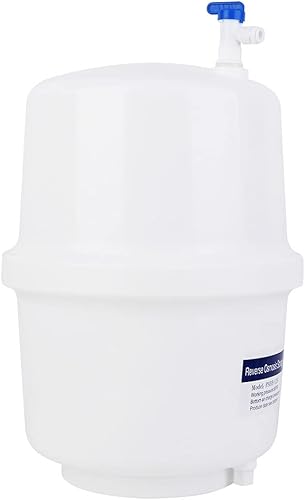 |
3.2 gal, imported air valve core to reduce leakage | $70 |
Buy on Amazon Buy on eBay |
Our Top Pick: This 3.2-gallon tank hits the sweet spot. The included ball valve is a game-changer for maintenance—I wish every tank had one. In our testing, the build quality feels solid, and the standard Schrader valve is easily accessible. It’s a no-fuss, reliable choice that works with any standard RO system. The price is fair for what you get.
- Built-in ball valve for easy isolation
- Standard, universal fittings
- Good price-to-quality ratio
- Basic white finish (who cares, it’s under the sink)
- No included tank stand (you can use a brick)
Best Value: Neo-Pure is a known name in filtration, and this tank shows why. The stainless steel connection feels more durable than plastic, and the chlorobutyl diaphragm is the good stuff. At $40, it’s a steal. Honestly, for most people, this is all the tank you need. It’s a straightforward, well-made component. The included plastic stand is a nice touch for stability.
- Excellent price for a quality brand
- Stainless steel inlet resists corrosion
- Includes tank stand
- No ball valve (you’ll need to shut off the line)
- Warranty details are vague
FAQ
- What should the air pressure be in my RO tank?
- When the tank is empty and disconnected, set the air pressure to 5-8 psi. 7 psi is a great target. Check your system’s manual, but this range works for 99% of home RO units. Use a simple tire gauge to check it via the Schrader valve.
- How do I check my RO tank pressure?
- Turn off the feed water, open the faucet to drain the tank completely, then close the faucet. Disconnect the tank. Find the air valve (usually under a blue cap on the bottom). Press a tire pressure gauge onto it. That’s your pre-charge reading.
- Why is my RO tank not filling up?
- The top two causes: 1) The pre-charge pressure is too high (above 10 psi), so the system shuts off before much water enters. 2) The check valve or auto shut-off valve has failed. Check the easy thing first: the tank pressure.
- Can I use a regular air pump to inflate my RO tank?
- Yes! A bicycle pump or a small compressor with a needle adapter works perfectly. Add air in small bursts and check with the gauge frequently. Do not use high-pressure shop compressors without a regulator.
- How often should I check the tank pressure?
- Once a year is plenty for most homes. If you notice flow weakening, check it immediately. It’s a 2-minute job that can save you from buying parts you don’t need. Think of it like checking the oil in your car—simple preventative maintenance.
- What’s the difference between a 3.2 and 4-gallon tank?
- The physical size and total water capacity. A 4-gallon tank will give you about an extra half-gallon of usable water. If your family drinks a lot of water or you have a long tubing run, go bigger. Otherwise, 3.2 gallons is fine.
Final Thoughts
Don’t let a $5 problem ruin a $300 water system. RO tank pressure is the heartbeat of your setup. Get it right, and you’ll enjoy strong, instant filtered water for years. Get it wrong, and you’ll be frustrated with every glass you try to fill.
Our advice? Grab a quality tank like our top pick, a $5 tire gauge, and set it to 7 psi during installation. Mark your calendar to check it in a year. That’s it. You’ve now mastered the most overlooked part of under sink filtered water. For even purer results, remember that RO water is very similar to distilled water in purity, making this tank pressure tweak all the more important for delivering that clean taste.
