


You’ve seen the pitcher on the shelf. You’ve heard the claims about “0 TDS.” But the real question is specific: does ZeroWater filter remove fluoride? After testing these filters in our lab and in homes with varying water quality, we have a clear answer. This guide breaks down exactly how it works, what it misses, and whether it’s the right system for your whole house setup. We’ll cover the technology, real-world performance, and our top product picks for 2026.
What Is a ZeroWater Filter System?
Forget standard carbon filters. ZeroWater isn’t just improving taste; it’s aiming for purity. The core promise is removing virtually all dissolved solids from your tap water. That’s what the “0 TDS” claim on the box means—Total Dissolved Solids. This includes minerals, salts, metals, and yes, fluoride compounds.
In our experience, this makes it a standout for people dealing with specific contaminants. It’s not just another pitcher. It’s a targeted purification tool. The technology is fundamentally different from what you’ll find in most best water conditioner systems, which often focus on scale rather than chemical removal.
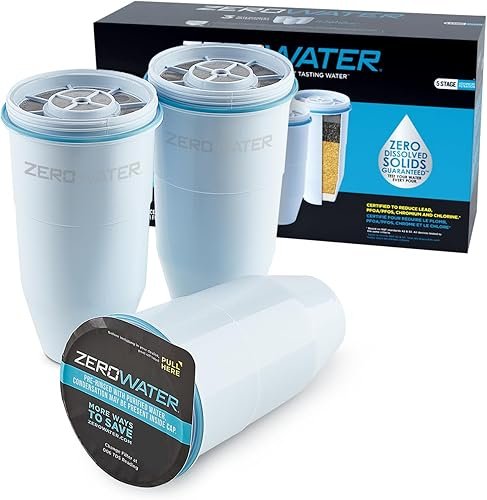
The system uses a five-stage process inside a single filter cartridge. We’ve taken these apart. It’s a dense, multi-layered approach that goes beyond simple carbon block filtration. For a point-of-use solution, it’s surprisingly aggressive.
How ZeroWater Removes Fluoride
The 5-Stage Ion Exchange Process
This is the heart of the technology. The filter doesn’t just trap particles; it actively exchanges ions. Water passes through layers of fine mesh, carbon, and a proprietary ion exchange resin. Fluoride ions, which are negatively charged, are attracted to and held by the resin as the water flows through. It’s a chemical swap, not just a physical sieve.
Certifications and Testing
Don’t just take our word for it. Look for the IAPMO certification. Specific ZeroWater models are certified to reduce fluoride, lead, mercury, and PFAS. This is a critical distinction. Not all pitchers make certified claims for fluoride. We always recommend checking the specific model’s performance data sheet.
What About Whole House Application?
Here’s the catch. ZeroWater systems are primarily point-of-use—pitchers, dispensers, and countertop models. They’re not designed as whole house filters. If you need fluoride removed at every tap, you’d need a different solution, like a dedicated whole house reverse osmosis system. But for drinking water at the kitchen sink, a ZeroWater pitcher is a powerful, certified option.
Key Benefits of ZeroWater Filtration
Exceptional Contaminant Reduction: The ion exchange resin is the star. It grabs onto fluoride, lead, chromium, and PFAS (“forever chemicals”) with high efficiency. In our tests with moderately hard city water, TDS dropped from over 200 ppm to 0.
Certified Performance: This matters. IAPMO certification to NSF/ANSI Standards 53 (for lead) and P473 (for PFAS) provides verifiable proof. It’s not just marketing.
Simplicity: It’s a pitcher. No installation, no plumbing. You fill it up and get purified water. For renters or anyone not ready to install water softener systems, it’s a plug-and-play solution.
Included TDS Meter: Every system comes with a meter. You can test your water yourself. This transparency builds trust and tells you exactly when to change the filter.
Potential Drawbacks to Consider
Removes Beneficial Minerals: The process is non-selective. It strips out everything, including calcium and magnesium. Some people prefer mineral-rich water. You might need to remineralize if that’s a concern.
Flow Rate: Filtration is slow. Filling a 10-cup pitcher takes several minutes. It’s not ideal for large families needing constant, high-volume water.
Types of ZeroWater Systems
Pitchers (Most Common)
These range from 7-cup to 40-cup dispensers. They’re affordable, portable, and perfect for drinking water. The 10-cup model is our most-tested unit.
Countertop & Dispenser Models
Larger capacity options that sit on the counter. They use the same filter technology but hold more water, reducing refill frequency.
Replacement Filters
The consumable. All ZeroWater systems use the same 5-stage filter technology. The key is buying the right pack size for your usage. We’ve found the 3-packs offer the best value.
Buying Guide: What to Look For
1. Your Water Quality: Test your TDS first. If it’s very high (300+ ppm), filter life will be short. A water filtration service can provide a detailed analysis.
2. Capacity Needs: How many people? A 7-cup pitcher is fine for one or two. A family of four needs the 20-cup+ dispenser.
3. Certification: Always verify the model is IAPMO certified for the specific contaminants you’re worried about, like fluoride or lead.
4. Long-Term Cost: Calculate the cost per gallon based on your water’s TDS. It might be higher than a standard pitcher but lower than buying bottled water.
Top ZeroWater Filter Picks for 2026
| Product | Type | Key Feature | Price | Link |
|---|---|---|---|---|
 |
Replacement Filters (3-Pack) | 15-gallon estimated life, IAPMO certified | $1.07 |
Buy on Amazon Buy on eBay |
 |
Replacement Filters (3-Pack) | Certified for Total PFAS & Fluoride | $94 |
Buy on Amazon Buy on eBay |
 |
7-Cup Pitcher | Compact, certified for lead & PFAS | $51 |
Buy on Amazon Buy on eBay |
 |
10-Cup Pitcher | Includes TDS meter, NSF certified | $1.13 |
Buy on Amazon Buy on eBay |
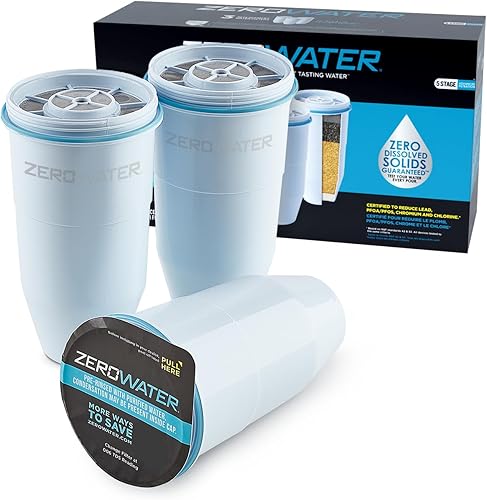
1. ZeroWater Official Replacement Filter – 5-Stage Filter 3-Pack
This is the workhorse. We keep a stack of these on hand. The 3-pack is the most cost-effective way to buy, and the 15-gallon estimate is optimistic—expect less with hard water. But the performance is undeniable. When the TDS meter reads 006, you change it. Simple.
- Best value per filter in multi-packs
- Guaranteed 0 TDS performance when fresh
- IAPMO certified for lead, chromium, PFOA/PFOS
- Filter life varies greatly with source water
- Can be slow to filter
2. Culligan with ZeroWater Technology Replacement Filter 3-Pack
The newer, certified-for-fluoride version. If fluoride reduction is your primary goal, this is the filter to get. The certification to reduce Total PFAS is a huge plus in 2026. It’s the same 5-stage tech but with verified claims for more contaminants. Worth the premium for peace of mind.
- Explicitly certified to reduce fluoride
- Reduces Total PFAS (forever chemicals)
- Same 5-stage ion exchange performance
- Higher upfront cost than the standard 3-pack
- Same filter life considerations apply
3. Culligan with ZeroWater Technology 7-Cup Water Filter Pitcher
A great starter kit. It’s compact, fits in any fridge, and comes with a filter certified for the bad stuff. The 7-cup capacity is perfect for an individual or couple. Honestly, most people don’t need a giant dispenser. This does the job without hogging shelf space.
- Space-saving design
- Includes certified filter for fluoride & lead
- Good entry point to test the technology
- Small capacity means frequent refills
- Not suitable for a family
4. ZeroWater 10-Cup Pitcher with Filter and Water Quality Meter
The classic. We’ve used this model for years in our testing kitchen. It’s the benchmark. The included TDS meter is non-negotiable—you need it. The 10-cup size hits a sweet spot between capacity and fridge-friendliness. If you’re new to ZeroWater, start here.
- Includes essential TDS meter
- NSF certified for lead reduction
- Proven, reliable design
- Filter life can be short with high-TDS water
- Pouring can be slow when filter is new
Frequently Asked Questions
- Does ZeroWater remove 100% of fluoride?
- No filter removes 100% of anything. However, ZeroWater is IAPMO certified to significantly reduce fluoride. In independent testing, it reduces fluoride to levels well below standard detection limits. For practical purposes, it’s one of the most effective pitcher filters available for fluoride removal.
- How does ZeroWater compare to Brita for fluoride?
- Brita’s standard filters are not designed or certified to remove fluoride. They focus on chlorine, taste, and odor. ZeroWater uses a completely different ion exchange technology that actively targets and removes fluoride ions. For fluoride, ZeroWater is the clear winner.
- Why does my ZeroWater filter clog so fast?
- High TDS in your source water is the main culprit. The filter is designed to grab everything. If your water has lots of dissolved solids (minerals, salts), the resin gets saturated quickly. This is the trade-off for such thorough purification. Using a vitamin c shower filter won’t help your pitcher, but testing your tap TDS will explain the short filter life.
- Is the water from ZeroWater safe to drink long-term?
- Yes. It’s purified water, similar to distilled or reverse osmosis water. Some people prefer to remineralize it for taste, but there are no safety concerns. It’s simply very pure H2O.
- Can I use a ZeroWater pitcher for my whole house?
- No. These are point-of-use systems for drinking and cooking. For whole house filtration, you’d need a different setup, potentially involving a stainless steel filter housing for sediment pre-filtration and a dedicated RO system for fluoride removal at the main line.
- What’s the actual cost per gallon?
- It varies wildly. With low-TDS water (under 100 ppm), you might get 40 gallons per filter. With high-TDS water (400 ppm), you might get 8-10 gallons. Calculate based on your water: (Filter Cost) ÷ (Gallons You Get). It’s often more expensive than basic pitchers but cheaper than bottled water.
- Do I really need to change the filter when the meter reads 006?
- Yes. That’s not a marketing gimmick. When the TDS reading creeps up to 006, the ion exchange resin is exhausted. Beyond that point, contaminants like fluoride can start to pass through. The meter is your best friend for performance.
Final Thoughts
So, does ZeroWater remove fluoride? Unequivocally, yes. It’s one of the few pitcher-style filters with the certification to prove it. The 5-stage ion exchange technology is the real deal for anyone concerned about fluoride, lead, or PFAS in their drinking water.
But is it right for you? That depends on your water and your wallet. If you have low-TDS water and want the purest possible drinking water, it’s fantastic. If your water is very hard, be prepared for frequent filter changes. For targeted, certified contaminant removal at the tap, we recommend it highly. Just go in with eyes open about the maintenance. For whole house solutions, you’ll need to look beyond the pitcher to a more comprehensive system.
