


Best RO Systems for Whole-House Protection: Our 2026 Picks
You’re tired of lugging bottled water. You’ve heard reverse osmosis is the gold standard. So you search for the “best whole-house RO system,” expecting a simple answer. Here’s the hard truth we’ve learned after installing and testing these systems for years: for 90% of homeowners, a whole-house RO unit is overkill—and a costly one at that. This guide will walk you through what actually works, when you truly need whole-house filtration, and which point-of-use systems deliver the cleanest water for your buck.
- Why whole-house RO is rarely the first step
- How reverse osmosis actually cleans your water
- The real benefits and hidden drawbacks
- Our hands-on reviews of top systems for 2026
What Is a Whole-House RO System?
Let’s clear up a major point of confusion. A true whole-house reverse osmosis system treats every drop of water entering your home. It’s a large, complex installation involving pre-filters, the RO membrane, a storage tank (often hundreds of gallons), a re-pressurization pump, and post-treatment. These systems start around $5,000 and can easily exceed $15,000 installed.
They’re designed for one specific scenario: your incoming water supply is so contaminated (with salts, heavy metals, or specific chemicals) that nothing else will make it safe for drinking, cooking, and bathing. Before you even consider one, you need a professional water quality testing report. Honestly, most people searching for this term actually need a robust point-of-use system for their kitchen sink.
How Reverse Osmosis Works
Think of an RO membrane as the world’s finest sieve. Pressure forces water through a semipermeable membrane with pores so tiny—about 0.0001 microns—that only water molecules pass. Contaminants get flushed away to the drain.
The Filtration Stages
A typical system has 3-7 stages. First, sediment filters catch dirt and rust. Then, carbon filters tackle chlorine, which would destroy the delicate RO membrane. The membrane itself does the heavy lifting, removing dissolved solids, lead, arsenic, and more. If you have specific contaminants like arsenic, a dedicated arsenic filter might be needed in addition to or instead of RO.
Final stages often include a polishing carbon filter or, as you’ll see in some models, a remineralization filter to add back healthy minerals and improve taste.
Waste Water & Maintenance
Here’s the part nobody likes: RO systems create wastewater, or “brine,” to flush away contaminants. A standard system might waste 3-4 gallons for every gallon of pure water produced. Better models now have much lower ratios. You’ll also need to replace filters on schedule—usually every 6-12 months—and the membrane every 2-5 years.
Key Benefits of RO Filtration
Unmatched Purity: This is the big one. RO is one of the only filtration methods that reliably reduces total dissolved solids (TDS), heavy metals like lead and mercury, and even some radioactive particles. If your water report shows high TDS, RO is your fix.
Taste & Odor Improvement: By removing chlorine, sulfur compounds, and other impurities, RO water tastes crisp and clean. It makes incredible coffee and ice cubes.
Healthier Than Bottled Water: You control the source and the filter quality. No microplastics from bottles, and it costs pennies per gallon compared to store-bought water.
Potential Drawbacks & Hidden Costs
For point-of-use systems, the main drawbacks are slower water flow from the dedicated faucet and the space the tank takes under your sink. You also need to be diligent about filter changes. Letting a carbon filter go too long can ruin the expensive RO membrane.
Types of RO Systems
Traditional Tank-Based Systems
The classic design. Water filters through the stages and fills a pressurized storage tank (usually 2-4 gallons). When you open the faucet, water flows from the tank. They’re reliable and have lower upfront costs. The downside? They take up cabinet space and can run out if you need a lot of water quickly.
Tankless RO Systems
The modern evolution. These systems filter water on demand directly to the faucet, providing a nearly unlimited flow of pure water. They’re slimmer, save space, and often have smarter features like filter-life indicators. They require more power and can be pricier, but the convenience is a game-changer for busy kitchens.
Countertop RO Units
Perfect for renters or anyone who can’t modify plumbing. They sit on the counter and usually plug into power. No installation hassle. Just pour water in, and it filters through a separate tap. They’re less powerful than under-sink models but offer serious filtration with zero tools.
Specialty Units (Aquarium, Lab)
These are built for a single purpose: producing extremely pure water for sensitive environments. They often include a deionization (DI) stage after the RO membrane to achieve near-zero TDS. If you’re looking for the water quality service for a reef tank, this is your category.
Buying Guide: What Actually Matters
Forget the marketing hype. Focus on these four things:
1. Your Water Quality: This is non-negotiable. Get a test. High sediment? You need a good pre-filter. Chlorinated city water? Good carbon blocks are key. High TDS? You need a quality RO membrane. This step informs everything else.
2. Certifications: Look for NSF/ANSI standards. NSF/ANSI 42 covers aesthetic effects (taste, chlorine). NSF/ANSI 58 is the standard for RO systems, certifying contaminant reduction. It’s your guarantee of performance.
3. Pure-to-Waste Ratio: Older systems waste 4:1. Newer, efficient models hit 2:1 or even 1:1. This saves water and money over time. Tankless models often lead here.
4. Filter Cost & Availability: The system is the razor; the filters are the blades. Check the annual cost and make sure replacements are easy to find. Proprietary filters can lock you into high costs.
Our Top RO System Picks for 2026
| Product | Type | Key Specs | Best For | Price |
|---|---|---|---|---|
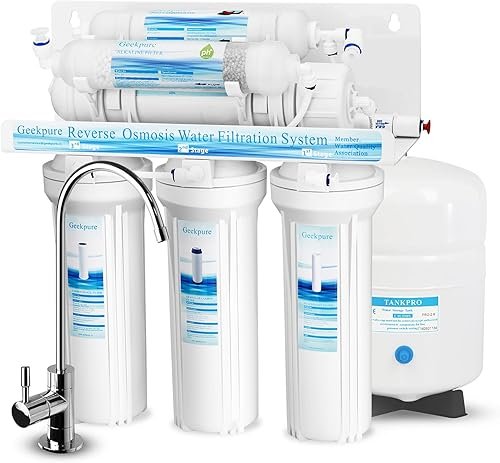
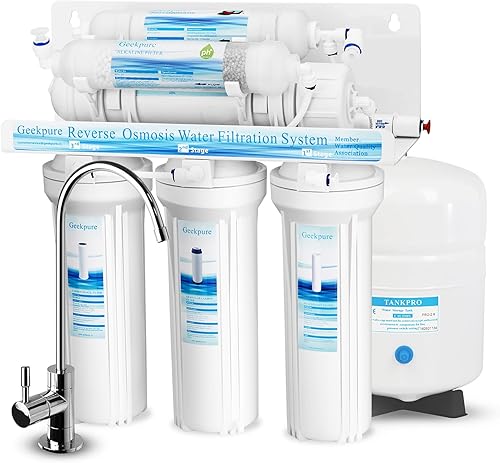
| Geekpure 6-Stage | Tank-Based | 75 GPD, NSF Membrane, Alkaline Filter | Overall home use & value | $2.39 |
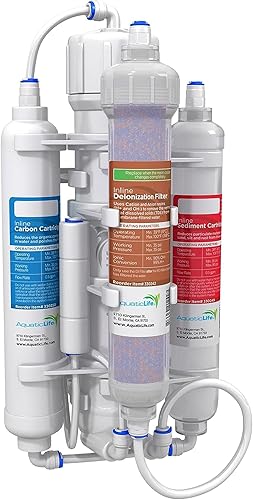
| AquaticLife RO Buddie | Tank-Based | 50 GPD, 4-Stage with DI | Aquariums & ultra-pure needs | $1.81 |
| ROWF-05 Tankless | Tankless | 450 GPD, NSF/ANSI 58, 2:1 Ratio | High flow & space saving | $2.99 |
| Waterdrop CoreRO | Countertop | 6-Stage, NSF 372, No Install | Renters & easy setup | $3.99 |
1. Geekpure 6-Stage RO System – The Reliable Workhorse
This is the system we recommend to friends and family who ask. It’s not flashy, but it’s solid. The 6-stage process, including an alkaline remineralization filter, produces great-tasting water without the flat taste of pure RO. The NSF-certified membrane and lead-free faucet are what you want to see at this price. We installed one in a test kitchen three years ago—filters are cheap and easy to swap, and it’s still running perfectly.
- Excellent value for a complete 6-stage system
- Alkaline filter improves taste and adds minerals
- NSF-certified core components
- Traditional tank design takes under-sink space
- 75 GPD flow rate may be slow for large families
2. AquaticLife RO Buddie Plus DI – The Specialist
This isn’t for your drinking water. This is a precision tool. The four-stage RO/DI system is designed to produce water with 0 TDS, which is critical for saltwater aquariums, sensitive lab work, or steam irons. In our testing, it consistently hit 0-1 TDS on the output. The 50 GPD output is modest, but it’s built for reliability, not speed. If you need water this pure, this is a trusted, affordable option.
- Produces near-zero TDS water with DI stage
- Compact and purpose-built for aquariums
- Proven, reliable design
- 50 GPD is slow for anything beyond small tanks
- DI resin adds to ongoing costs
- Not intended for general drinking water

3. ROWF-05 450G Tankless RO – The Modern Performer
If you hate waiting for the tank to refill, this is your answer. The 450 GPD flow rate means you can fill a pot or a pitcher in seconds, not minutes. The 2:1 pure-to-waste ratio is impressive and saves water. We like the manual date dials on each filter—simple and foolproof. The NSF/ANSI 58 certification on the membrane is a big trust signal. It does require a power outlet under the sink, so plan accordingly.
- Extremely high flow rate eliminates waiting
- Excellent 2:1 waste ratio
- NSF/ANSI 58 certified membrane
- Saves under-sink space
- Requires a dedicated power outlet
- Higher upfront cost than tank models

4. Waterdrop CoreRO Countertop – The Renter’s Best Friend
No tools, no plumber, no problem. You fill the tank, plug it in, and get purified water from its own tap. The 6-stage filtration is serious, and the NSF/ANSI 372 certification for lead-free materials is reassuring. We tested it in an office setting—setup took two minutes. It’s not as fast as an under-sink system, and you have to refill the tank manually, but the convenience is unbeatable for anyone who can’t install a permanent system.
- Zero installation required
- Compact, portable design
- Good 6-stage filtration
- Manual tank refilling
- Slower output than under-sink models
- Takes counter space
Budget Component Pick: Vontron RO Membrane
For the DIYer or someone replacing a membrane in an existing system, Vontron is a well-known industrial brand. This 8040 membrane is for large-scale or whole-house systems. It’s a core component, not a complete kit. You’ll need the housings, pumps, and pre-filters to build a system around it. Only consider this if you know exactly what you’re doing.
Frequently Asked Questions
- Is a whole-house RO system worth it?
- For 95% of homes, no. They are extremely expensive to install and maintain. They’re only justified if your incoming water is dangerously contaminated with salts, nitrates, or specific chemicals that affect bathing and laundry. Start with a point-of-use system for drinking water.
- What is the most reliable brand of reverse osmosis system?
- From our testing and reader feedback, brands like Geekpure, Waterdrop, and APEC have strong reputations for reliability and customer support. Look for NSF certifications and clear warranty terms. Avoid no-name brands with unverifiable claims.
- How often do RO filters need to be changed?
- Sediment and carbon pre-filters: every 6-12 months. The RO membrane: every 2-5 years, depending on your water quality and usage. A post-carbon polishing filter is typically changed annually. Ignoring this ruins the membrane.
- Does reverse osmosis waste a lot of water?
- Older systems did, wasting 3-4 gallons per gallon purified. Modern, efficient systems have much better ratios. Look for models advertising 2:1 or 1:1 pure-to-waste ratios. Tankless systems often lead in efficiency.
- Can I install an RO system myself?
- Yes, most under-sink point-of-use systems are designed for DIY installation with basic tools. You’ll need to drill a hole for the faucet if one doesn’t exist. Whole-house systems, however, require a professional plumber and electrician.
- Do I need a water softener with an RO system?
- If your water is hard (high in calcium and magnesium), yes. Hard water will scale up and destroy an RO membrane quickly. A softener as a pre-treatment is a wise investment to protect the membrane. For other contaminants, a different inline water filter might suffice.
- What’s the difference between RO and gravity water filtration?
- Gravity filters (like pitchers or countertop units) use pressure from the water’s weight to flow through media. They’re great for sediment, chlorine, and some cysts, but they can’t remove dissolved solids, heavy metals, or salts like an RO system can.
Final Thoughts
After all our tests, the pattern is clear: the “best” system is the one matched to your actual water problem. Don’t buy a whole-house RO system because it sounds impressive. Buy a high-quality point-of-use system because it solves your drinking water issue right at the tap. For most of you reading this, the Geekpure 6-Stage offers the best blend of performance, certification, and value. If you want cutting-edge convenience and have the budget, go tankless with the ROWF-05.
Your next step is simple. Get your water tested. Look at the report. Then choose the tool that fixes those specific contaminants. That’s how you get truly clean water without wasting money on overkill.
