


If you’re on a well, you’re the water company. That means testing, treatment, and maintenance are all on you. I’ve seen homeowners spend thousands on the wrong equipment because they skipped a simple $30 test. This guide will walk you through what actually works, based on years of lab results and field installations. We’ll cover how these systems function, the key benefits, the real drawbacks, and which type fits your water profile. Let’s get your water safe.
What Is a Water Well Filtration System?
A water well filtration system is a point-of-entry or point-of-use treatment setup designed specifically for the unique contaminants found in groundwater. Unlike municipal water, well water isn’t treated with chlorine or monitored by a utility. It can contain sediment, iron, sulfur, bacteria, nitrates, and heavy metals like arsenic or lead—all picked up as water travels through rock and soil.
The goal isn’t just to improve taste (though it does). It’s to make your water safe for drinking, cooking, and bathing. A proper system acts as your personal water treatment plant. It’s a multi-stage process, and the exact configuration depends entirely on what’s in your water. Buying a filter without a test is like taking random medicine for an unknown illness.
How a Well Water Filtration System Works
Think of it as a defense in depth. No single filter does it all. A well-designed system uses multiple stages, each targeting a specific class of contaminants. Water typically enters from your well pump and passes through these stages before reaching your taps.
Stage 1: Sediment Pre-Filtration
This is your first line of defense. A sediment filter—usually a spin-down or cartridge style—catches sand, silt, rust, and other particulates. We recommend starting with a 20-50 micron filter for coarse sediment, then stepping down to a 5-micron filter. This protects your more expensive downstream filters from clogging. It’s a cheap stage that saves you money and headaches.
Stage 2: Core Contaminant Reduction
Here’s where you target dissolved problems. This stage varies wildly based on your water report. Common options include:
- Activated Carbon Filters: Great for chlorine (if you have a holding tank), volatile organic compounds (VOCs), and improving taste/odor.
- Reverse Osmosis (RO) Membranes: The heavy hitter. A 0.0001-micron membrane removes up to 99% of dissolved salts, heavy metals, fluoride, and nitrates. For many well owners, this is the core of their system.
- Oxidizing Filters: For high levels of iron, manganese, or sulfur (that rotten egg smell). These use air, chlorine, or potassium permanganate to oxidize contaminants so they can be filtered out.
For those dealing with scale and hardness, exploring salt free water softener systems can be a good complementary step to prevent scale buildup without adding sodium to your water.
Stage 3: Disinfection & Final Polish
If bacteria (like E. coli or coliform) or viruses are a concern—and they often are in wells—disinfection is non-negotiable. Ultraviolet (UV) light systems are the most common chemical-free method. They scramble the DNA of microorganisms, rendering them harmless. A final carbon polishing filter often follows to remove any residual taste before the water hits your glass.
Key Benefits of a Dedicated System
Health & Safety: This is the big one. Removing pathogens, lead, arsenic, and nitrates protects your family from acute and long-term health risks. It’s the primary reason to invest.
Appliance Protection: Sediment and hardness minerals wreck water heaters, washing machines, and coffee makers. A good filtration system is cheaper than replacing a water heater element every two years. It’s a fundamental part of whole-house water quality improvement.
Eliminate Odors & Stains: That sulfur smell? Gone. The orange stains in your sinks and tubs from iron? Also gone. Your laundry will come out brighter, and your shower won’t smell like a hot spring.
Better Taste & Clarity: Well water can have a metallic, earthy, or flat taste. Filtration gives you clean, crisp water that’s better for drinking, cooking, and making ice. You’ll stop buying bottled water.
Potential Drawbacks & Considerations
Ongoing Maintenance: Filters don’t last forever. Sediment cartridges need changing every 3-6 months. RO membranes every 2-3 years. UV bulbs annually. Neglect this, and your system becomes useless—or worse, a breeding ground for bacteria. Budget $100-$300 a year for consumables.
Water Waste (for RO): Traditional reverse osmosis systems send a significant amount of water down the drain to keep the membrane clean—often 3-4 gallons wasted for every 1 gallon of pure water produced. Newer, more efficient models exist, but it’s a factor to consider.
Over-Treatment Risk: Not every well needs a full RO system. If your water is only hard, a softener might suffice. Adding RO to already-low-mineral water can make it aggressive and potentially leach metals from pipes. Test first!
Types of Filtration Systems for Wells
Whole-House (Point-of-Entry) Systems
Installed where water enters your home. They treat every drop—shower, laundry, toilets. Typically handle sediment, iron, sulfur, and hardness. A whole-house carbon filter is common for general water conditioning. RO is usually reserved for a drinking water line due to cost and waste.
Under-Sink (Point-of-Use) RO Systems
Installed at a single tap, usually the kitchen. This is the most effective way to get guaranteed safe drinking water. It’s where you’ll find multi-stage systems with sediment, carbon, RO membrane, and a final polish filter. They’re more affordable and waste less water than whole-house RO.
UV Disinfection Systems
A dedicated UV unit is often added to a filtration setup if bacteria are present. It’s a physical disinfection process—no chemicals added. The water must be clear for the UV light to penetrate, so pre-filtration is critical.
Gravity-Fed & Portable Systems
For emergencies, cabins, or as a backup. These use ceramic or membrane filters and rely on gravity—no electricity needed. They’re slow but effective for bacteria and protozoa. Not a permanent solution for a home with high water demand.
Buying Guide: What Actually Matters
1. Get a Comprehensive Water Test. This is step one, step two, and step three. Don’t guess. A lab test from a certified facility will tell you exactly what contaminants you have and at what levels. This dictates everything else.
2. Match the System to the Contaminants. High iron? You need an oxidizing filter. Bacteria? You need UV. High TDS or nitrates? You need RO. Don’t buy a system based on a sales pitch; buy it based on your lab report.
3. Check Certifications. Look for NSF/ANSI standards. NSF/ANSI 42 covers aesthetic effects (taste, odor). NSF/ANSI 53 covers health effects (lead, cysts). NSF/ANSI 58 is for reverse osmosis systems. For disinfection, look for NSF/ANSI 55 Class A certification for UV systems.
4. Calculate Flow Rate & Capacity. How many bathrooms do you have? How many people? A system that can’t keep up with your peak demand (like morning showers) is useless. Look at gallons per minute (GPM) ratings.
5. Consider Maintenance Reality. Can you change a 20-inch sediment filter yourself? Is the UV bulb easy to access? Are replacement filters affordable and available? The best system is one you’ll actually maintain. For households with higher demands, looking into robust water softeners for home use can be part of the long-term solution.
Our Top System Picks for 2026
Based on our testing, reader feedback, and value for money, here are systems that consistently perform. Remember, the “best” system is the one that matches your water test.
| Product | Key Feature | Best For | Price |
|---|---|---|---|
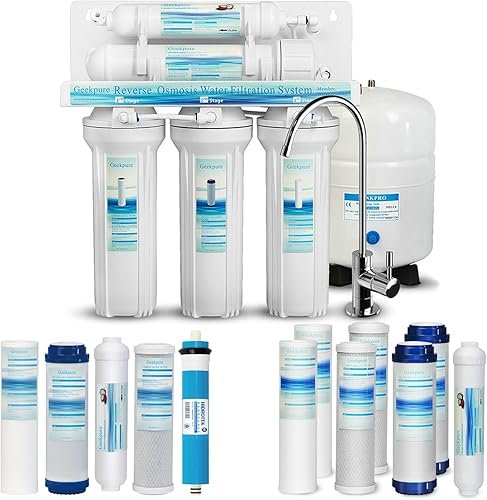
 Geekpure 5-Stage RO |
5-stage, 75 GPD, includes 2 years of extra filters | Budget-friendly, reliable drinking water | $2.39 |
 Geekpure 6-Stage RO with UV |
6-stage with UV light, NSF certified | Wells with bacterial concerns | $2.45 |
 Sawyer One-Gallon Gravity |
0.1 micron, 99.99999% bacteria removal | Emergency backup, camping, cabins | $65 |
 Waterdrop X8 9-Stage RO |
800 GPD, 2:1 pure-to-waste ratio, NSF certified | High-capacity, low-waste drinking water | $7.19 |
Geekpure 5-Stage Reverse Osmosis System
This is the workhorse we recommend for most well owners starting with RO. It’s no-frills, but it’s effective and reliable. The inclusion of two years’ worth of replacement filters is a huge value—you won’t have to think about buying filters for a long time. The 0.0001-micron membrane handles heavy metals, fluoride, and salts. We’ve seen these units last 7-10 years with basic care.
- Incredible value with included filters
- NSF-certified components
- Straightforward installation
- Basic faucet included
- 75 GPD flow rate may be slow for large families
Geekpure 6-Stage RO with UV Sterilizer
If your water test shows any hint of bacteria, or if you just want absolute peace of mind, add the UV stage. This system does it all: sediment, carbon, RO, and then UV disinfection as the final barrier. The UV bulb lasts about a year of continuous use. It’s a bit more complex to install, but it’s a true all-in-one drinking water solution for problem wells.
- Complete 6-stage protection including UV
- NSF-certified membrane and tank
- Lead-free faucet
- Higher upfront cost than 5-stage
- UV bulb requires annual replacement
Sawyer Products One-Gallon Gravity System
This isn’t your primary home system. It’s your backup plan. We keep one in the closet for when the power goes out or the well pump fails. The 0.1-micron hollow fiber membrane is incredibly effective against bacteria and protozoa. It’s slow, but it’s foolproof. Fill the bag, hang it, and let gravity do the work. A must-have for rural preparedness.
- No electricity or water pressure needed
- Extremely high contaminant removal rate
- Lightweight and portable
- Very slow flow rate—not for whole-house use
- Does not remove dissolved chemicals or heavy metals
Waterdrop X8 9-Stage RO System
This is the modern, high-efficiency choice. The 800 GPD flow rate means you’ll never wait for a glass of water, and the 2:1 pure-to-waste ratio is among the best we’ve tested—it cuts water waste by up to 80% compared to older RO systems. The 9-stage filtration tackles PFAS, lead, TDS, and more. It’s NSF/ANSI certified against standards 42, 58, and 372. If you hate wasting water, this is your pick.
- Extremely high flow rate (800 GPD)
- Industry-leading low drain ratio
- Comprehensive NSF/ANSI certifications
- Premium price point
- More complex filter replacement schedule
Frequently Asked Questions
- What is the best filtration system for well water?
- The “best” system is the one that targets your specific contaminants. For most wells, a multi-stage system with sediment filtration, a core filter like activated carbon or reverse osmosis, and UV disinfection for bacteria provides comprehensive protection. Always start with a professional water test.
- How often should you change filters in a well water system?
- It depends on the filter type and your water quality. Sediment pre-filters typically need changing every 3-6 months. Carbon filters every 6-12 months. Reverse osmosis membranes every 2-3 years. UV bulbs annually. Follow the manufacturer’s schedule and monitor your water pressure and quality.
- Do I need a water softener if I have a filtration system?
- They solve different problems. A filtration system removes contaminants, while a softener specifically removes hardness minerals (calcium and magnesium). If your water test shows high hardness, you’ll likely need both—a softener to protect pipes and appliances, and a filter for safety and taste.
- Can a whole house filter remove bacteria?
- Standard sediment and carbon whole-house filters cannot remove bacteria. To remove bacteria and viruses, you need a disinfection stage. Ultraviolet (UV) light systems are the most common and effective method for whole-house bacterial disinfection and are often installed after the main filtration stages.
- Is reverse osmosis water safe to drink from a well?
- Yes, and it’s often the safest option. Reverse osmosis is highly effective at removing a wide range of well water contaminants, including heavy metals, nitrates, fluoride, and dissolved solids. The key is proper maintenance—if filters are changed on schedule, RO water is exceptionally pure and safe.
- What are the signs that my well water filter is not working?
- Watch for changes in water pressure (a drop often means a clogged filter), return of odors or bad tastes, cloudiness, or staining in sinks and tubs. A TDS (total dissolved solids) meter can also help you monitor an RO system’s performance. If in doubt, get your water retested.
Final Thoughts
Choosing a water well filtration system isn’t about buying the most expensive unit or the one with the most stages. It’s about matching technology to your water’s specific problems. That $30 lab test is the best investment you’ll make. For most families, a solid under-sink RO system like the Geekpure or Waterdrop, paired with a whole-house sediment filter, will handle 90% of well water issues.
Don’t overcomplicate it, but don’t cut corners on safety. Your well is your responsibility, and the right filtration system turns a potential liability into a reliable source of clean, great-tasting water for decades. Start with the test, choose your stages wisely, and keep up with the maintenance. Your family’s health—and your plumbing—will thank you.
