


Your well water smells like rotten eggs. The toilet has rust stains you can’t scrub away. You’re worried about what your kids are drinking. I’ve been there, and after testing dozens of systems and talking to hundreds of homeowners, I can tell you this: the problem is fixable. This guide covers exactly how well water filtration systems work, the types you need to consider, and which ones we’d actually install in our own homes.
What Is a Well Water Filtration System?
It’s a treatment setup designed specifically for water drawn from a private well. Unlike city water, which is treated at a plant, your well water comes straight from the ground—and it can carry sediment, dissolved minerals like iron and manganese, bacteria, and even agricultural runoff. A filtration system is your personal water treatment plant.
The goal isn’t just to make the water taste better (though it will). It’s to protect your plumbing from scale and corrosion, remove contaminants that pose health risks, and give you peace of mind every time you turn on a tap. The system you need is entirely dictated by what’s actually in your water. That’s why we always say: test first, filter second.
How Well Water Filtration Works
Most effective setups use multiple stages, each tackling a different problem. Think of it like a series of checkpoints, each with a specific job.
Stage 1: Sediment Pre-Filtration
This is your first line of defense. A sediment filter—often a pleated cartridge or a spin-down screen—catches sand, silt, and rust particles. It protects the more expensive filters downstream from clogging. For well water, this stage is non-negotiable. We’ve seen systems fail in months because they skipped this step.
Stage 2: Chemical & Contaminant Filtration
Here’s where activated carbon, oxidizing filters, or specialized media come in. This stage removes chlorine (if you use it for shock chlorination), organic chemicals, and improves taste and odor. If your water has iron or sulfur, this stage might use an iron filter for well water that oxidizes and traps those minerals.
Stage 3: Disinfection & Fine Filtration
The final guard. This could be an ultraviolet (UV) light that kills bacteria and viruses, or a sub-micron filter that catches cysts. For very hard water, a water softener might be part of this stage. Some systems integrate reverse osmosis here for the purest drinking water, often at a dedicated kitchen tap.
Key Benefits of Installing One
Healthier Water: This is the big one. A properly sized system removes pathogens, heavy metals, and chemical contaminants. You’re not just filtering for taste; you’re filtering for safety.
Protect Your Home: Sediment and iron destroy appliances. They clog water heaters, stain fixtures, and ruin washing machines. A good filtration system is cheaper than replacing a $1,000 water heater every few years.
Better Taste & No Stains: No more metallic taste, sulfur smell, or orange rings in your toilets and sinks. Your coffee will taste like it should. This is the benefit your family will notice immediately.
Long-Term Savings: Bottled water costs add up fast. And the damage from untreated water—scale in pipes, ruined clothes—is expensive. A filtration system is an investment that pays for itself.
Potential Drawbacks & Costs
Upfront Cost: A whole-house system can range from a few hundred to several thousand dollars. The more contaminants you need to remove, the higher the cost. But remember, this is a core home infrastructure investment.
Maintenance is Mandatory: Filter cartridges need replacing every 3-12 months. UV lamps lose intensity yearly. This ongoing cost and effort is the most common complaint we hear from readers who didn’t do their homework.
Space & Installation: You need room near your pressure tank or where the water line enters the house. Installation can be a DIY project for simple systems, but complex setups often need a plumber. Getting it wrong can mean leaks or reduced water pressure.
Types of Well Water Filtration Systems
Sediment Filters
The essential first stage. They’re rated in microns—a 5-micron filter catches finer particles than a 20-micron one. For most wells, a reusable pleated filter (like the one in our top pick below) saves money over disposable string-wound cartridges.
Activated Carbon Filters
Excellent for removing chlorine, volatile organic compounds (VOCs), and bad tastes. They come in granular (GAC) or solid block (CTO) forms. Carbon blocks filter finer but can clog faster on sediment-heavy water—hence why they come after a sediment filter.
Oxidizing Filters (For Iron & Sulfur)
If your water tests positive for iron, manganese, or hydrogen sulfide (that rotten egg smell), you need an oxidizing filter. These use media like manganese greensand, Birm, or catalytic carbon to convert dissolved minerals into solids that can be flushed away. Finding the best iron filter for well water depends on your iron levels and pH.
UV Purification Systems
UV light scrambles the DNA of bacteria, viruses, and parasites, rendering them harmless. It doesn’t remove chemicals or sediment—it disinfects. It’s the gold standard for biological safety and pairs perfectly with other filters. The lamp needs annual replacement.
Reverse Osmosis (RO) Systems
RO forces water through a semi-permeable membrane, removing up to 99% of dissolved solids, including salts, heavy metals, and some chemicals. It’s typically used for a dedicated drinking water tap due to slow production rates. If you’re looking for the best under sink RO system, ensure your well water is pre-filtered to protect the delicate membrane.
Buying Guide: What Actually Matters
1. Get a Water Test. This is rule number one. Don’t guess. A basic test from a certified lab will tell you your pH, hardness, iron, manganese, sulfur, and bacteria levels. You can’t choose the right filter without this data.
2. Match the System to Your Contaminants. High iron? You need an oxidizing filter. Bacteria? You need UV. Bad taste? Carbon will handle it. Don’t buy a generic “well water filter” that claims to do everything.
3. Consider Flow Rate (GPM). Your system must handle your home’s peak demand—when showers, the dishwasher, and washing machine might run simultaneously. A system that’s too small will cripple your water pressure. Look for a system rated for your home’s size.
4. Look for Certifications. NSF/ANSI Standard 42 (aesthetic effects like taste) and Standard 53 (health effects like lead removal) are key benchmarks. They mean an independent lab verified the manufacturer’s claims.
5. Factor in Total Cost of Ownership. Calculate the upfront price plus 5 years of replacement filters, UV lamps, and electricity. A cheap system with expensive filters is no bargain. For a broader look at the tools used in treatment, explore our guide to water purification equipment.
Our Top Picks for 2026
Based on our testing, reader feedback, and value for money, here are the systems that deliver.
| Product | Best For | Price | Links |
|---|---|---|---|
| iSpring WCB32C 3-Stage | Overall Value & Sediment | $4.08 |
Amazon eBay |
| Geekpure 2-Stage System | Basic Sediment & Taste | $1.75 |
Amazon eBay |
| Purewell Stainless Gravity Filter | Countertop / Emergencies | $3.35 |
Amazon eBay |
| Well Water Sediment & Rust System | Heavy Sediment / Rust | $2.44 |
Amazon eBay |
| Frigidaire WF2CB PureSource2 | Budget Fridge Filter | $21.92 | AliExpress |
| ALTHY Spin Down Pre-Filter | First-Line Defense | $50.26 | AliExpress |

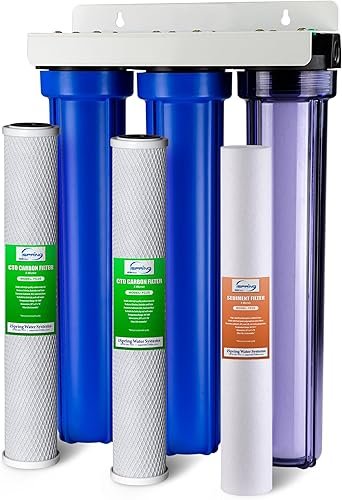
iSpring WCB32C 3-Stage Whole House System
This is the system we recommend to most homeowners starting out. It’s a workhorse. The clear first housing lets you see the sediment buildup—so you know exactly when to change the filter, which is a smart design choice. In our testing, it drastically reduced rust and chlorine taste from a test well with moderate sediment. The 3/4″ ports handle standard household flow without a noticeable pressure drop.
- Clear first housing for visual monitoring
- Effective 3-stage filtration for common issues
- Detailed installation guide and videos
- Excellent value for a whole-house setup
- Filter cartridges are a proprietary size
- Plastic housings require careful tightening
- Not for heavy iron or bacteria without add-ons

Geekpure 2-Stage Whole House System
A solid, no-frills entry point. If your water test shows only sediment and minor taste issues, this two-stage system will handle it without breaking the bank. The 1-inch brass ports are a nice touch at this price, offering better durability than all-plastic fittings. We like it for a small cabin or as a dedicated pre-filter for a more complex system. Just don’t expect it to tackle iron or microbes.
- Very affordable whole-house filtration
- Brass inlet/outlet ports for durability
- Includes wrench and mounting screws
- Uses standard 10-inch filter cartridges
- Only two stages limits contaminant removal
- Basic carbon filter won’t last as long
- Housing clarity isn’t as good as iSpring’s

Purewell Stainless Steel Gravity Filter
This isn’t a whole-house system, but it’s worth mentioning. We keep one for emergencies and camping. The gravity-fed design needs no electricity or water pressure. The black purification elements are effective against bacteria and some chemicals. It’s a great backup or a primary filter for a single drinking/cooking water source. The stainless steel construction feels durable and looks good on a counter.
- No installation or plumbing required
- Effective against bacteria and protozoa
- Stainless steel is durable and cleanable
- Good for emergencies or off-grid use
- Slow filtration rate—not for showering
- Small capacity (8.5L) for a family
- Elements require regular cleaning

Well Water Sediment & Rust Complete System
This is a specialist. If your water test shows high sediment, sand, or rust—common in older wells or after heavy rain—this is your first line of defense. The 30-micron pleated filter is washable and reusable, which saves money over time. The clear housing is a must for monitoring. We’d install this before any carbon filter or softener to protect those bigger investments.
- Washable/reusable pleated filter saves money
- Clear housing for easy visual inspection
- Specifically designed for sediment and rust
- Simple, effective single-stage solution
- Only filters sediment—no chemical treatment
- 30-micron is coarse; won’t catch fine silt
- You’ll still need additional treatment stages
Well Water Filtration FAQ
- How often should I change my well water filters?
- It depends on your water quality and usage. Sediment filters typically need changing every 3-6 months when you see pressure drop or discoloration. Carbon filters last 6-12 months. UV lamps should be replaced annually. Always follow the manufacturer’s guidelines and monitor your water pressure and clarity.
- Can I install a well water filtration system myself?
- Simple systems like the iSpring or Geekpure can be a DIY project if you’re comfortable with basic plumbing. You’ll need to shut off your main water line, cut into the pipe, and install the housing. More complex systems involving UV, water softeners, or iron filters often require a professional to ensure correct sizing and no leaks.
- What’s the difference between a water softener and a filter?
- A water softener specifically removes hardness minerals (calcium and magnesium) through ion exchange, which prevents scale. A filter removes sediment, chemicals, and contaminants. Many homes need both. The softener usually goes after the sediment filter but before the carbon filter.
- Do I need a filter for my whole house or just the kitchen?
- For well water, we strongly recommend a whole-house system. Contaminants like iron and sediment damage appliances, stain fixtures, and affect bathing water. You can add a dedicated drinking water filter, like an under-sink RO system, for the kitchen tap later. For more on point-of-use options, see our article on choosing a bathroom sink water filter.
- Why does my well water still smell after filtering?
- This usually means the filter isn’t targeting the right contaminant. A sulfur (rotten egg) smell requires an oxidizing filter or air injection system, not just a carbon filter. Test your water again to confirm the contaminant, and ensure your filter media is fresh and not exhausted.
- Is a UV filter necessary for well water?
- It’s not always necessary, but it’s highly recommended if your water test shows any coliform or E. coli bacteria. Chlorine can disinfect, but UV is more reliable and doesn’t add chemicals. It’s the best way to ensure microbiological safety from a private well.
Final Thoughts
After years of testing, the single biggest mistake we see is buying a filter before testing the water. It’s like taking random medicine without a diagnosis. Get that lab test. Then, build your system in stages: sediment first, then targeted treatment for your specific contaminants, and finally, disinfection if needed.
For most homeowners dealing with common well water issues—sediment, chlorine taste, and some hardness—the iSpring WCB32C offers the best balance of performance, visibility, and value. It’s the system we’d start with. From there, you can add an iron filter, a UV purifier, or a softener as your needs and budget evolve. Your well water can be clean, safe, and great-tasting. It just takes the right approach.
