


Water Testing Equipment: Your 2026 Guide to Knowing What’s In Your Tap
You just installed a new filter. The water tastes better. But is it actually safer? After testing dozens of systems and talking to countless plumbers, I can tell you this: guessing is the most expensive mistake you can make. The right water testing equipment turns mystery into clarity.
This guide covers:
- What modern home water testing kits actually are
- How different test types work (and their limits)
- The real benefits and drawbacks of at-home testing
- A clear breakdown of the main equipment types
- Our top picks based on hands-on use
What Is Water Testing Equipment?
Water testing equipment is any tool that analyzes your water’s composition. It tells you what’s dissolved in it, what’s floating in it, and whether any of it poses a risk. This isn’t just for people with wells. City water can have issues too—old pipes leach lead, treatment plants add chlorine or chloramine, and hardness minerals scale up your appliances.
At its core, this equipment gives you data. And data is power. It tells you if you need a simple carbon block filter for taste and odor, or if you have a more serious contamination problem requiring a different solution. We’ve seen it save homeowners thousands by pinpointing the exact fix needed.
The gear ranges from $15 test strips to $500+ digital photometers used by professionals. For a homeowner’s first step, you don’t need the pro gear. You need reliable, understandable results.
How Water Testing Equipment Works
Colorimetric Methods (Test Strips & Liquid Kits)
This is the most common home method. You expose a reactive pad or liquid reagent to your water. A chemical reaction happens, causing a color change. You then compare that color to a provided chart. It’s simple chemistry. The strip for lead, for example, contains a compound that binds to lead ions and turns a specific shade of pink or red.
Electrochemical Methods (Digital Meters)
These use probes to measure electrical properties. A TDS (Total Dissolved Solids) meter measures conductivity—the more ions (minerals, salts, metals) in the water, the higher the conductivity. pH meters use a glass electrode sensitive to hydrogen ions. They’re more precise than strips but measure different things. A TDS meter won’t tell you if the dissolved solids are healthy calcium or harmful lead.
Understanding the Limits
Here’s the critical part: a test is only as good as its design. A strip that tests for “heavy metals” might only detect lead down to 15 parts per billion (ppb). The EPA action level is 15 ppb. So it might give you a “pass” when lead is right at the dangerous threshold. This is why knowing the detection limit matters.
Key Benefits of Testing Your Water
Identify Hidden Problems. You can’t taste lead. You can’t see nitrates. Testing is the only way to know for sure what’s coming out of your tap. We’ve found shocking lead levels in homes with “perfectly good” city water, all due to a single corroded pipe.
Save Money on Filtration. Don’t buy a $600 reverse osmosis system if your only issue is chlorine. A simple pitcher filter might do. Testing tells you what to target. This is especially true if you’re considering a whole-house POE water filter—you need to know what you’re filtering for.
Protect Your Health & Home. High hardness scales up water heaters and coffee makers, shortening their lifespan. Knowing your hardness level can inform decisions that affect the cost of water heater replacement down the line. Acidic water (low pH) corrodes copper pipes, leading to blue-green stains and leaks.
Verify Your Filter Works. You installed a filter. Great. Test the water before and after. It’s the only way to confirm it’s doing its job. This is non-negotiable for health-critical contaminants.
Potential Drawbacks & Limitations
User Error is Real. Did you dip the strip for exactly two seconds? Did you wait exactly 30 seconds before comparing? Timing and technique matter. Rushing leads to false readings.
They Test a Snapshot. Water quality changes. Contaminant levels can fluctuate based on season, water source, and even time of day. A single test is a single data point.
Not All Tests Are Equal. Cheap, no-name strips from unknown online sellers can be wildly inaccurate. We’ve seen strips that couldn’t distinguish between soft and very hard water. Stick to reputable brands.
Types of Water Testing Equipment
1. Multi-Parameter Test Strips
The workhorse for homeowners. One strip has 8-16 different pads, each testing for a different parameter like pH, hardness, chlorine, nitrate, and sometimes lead or copper. They’re fast (results in 30-120 seconds) and cheap per test. Perfect for a broad initial survey of your water.
2. Liquid Drop Kits (Titration)
Common for testing hardness, chlorine, and pH in pools and spas. You add reagent drops to a water sample until a color change occurs. The number of drops used calculates the concentration. More hands-on and slightly more accurate than strips for specific parameters, but slower.
3. Digital Meters
These give a numerical readout. TDS meters are the most common and affordable. They’re great for checking the performance of a reverse osmosis system—a good RO system should drop TDS by 90% or more. Dedicated pH meters require calibration but are very precise. If you have a specific, ongoing concern, a digital meter for that parameter is a smart buy.
4. Professional Mail-In Lab Kits
You buy a kit, collect a sample, mail it to a lab, and get a detailed report. This is the gold standard for accuracy and breadth of testing. It’s the right choice if you have serious concerns (e.g., pregnant woman in the house, known local contamination) or need data for legal/real estate purposes.
Buying Guide: What Actually Matters
1. What Are You Testing For? Don’t buy blind. If you’re on city water, check your annual water quality report (it’s free). It lists detected contaminants. Use that to guide what you test for at home. If you’re on a well, you need a broader panel including bacteria and nitrates.
2. Certification & Reputation. Look for strips or kits from established brands in the water or pool industry. Some are NSF certified, which is a good sign. Read reviews from people who verified results against lab tests.
3. Detection Ranges. Does the test’s range cover the EPA or WHO safety guideline? For lead, you want a test that can detect at least down to 15 ppb. For chlorine, a range of 0-10 ppm is useful.
4. Ease of Use & Clarity. Is the color chart easy to read? Are the instructions clear? Some charts have very similar colors for vastly different readings. This is where digital meters have an edge.
For most folks starting out, we recommend a quality multi-parameter strip kit. It gives you the biggest picture for the least money and effort. From there, you can drill down with more specific tests.
Our Top Water Testing Picks for 2026
We’ve used countless strips and kits over the years. Here are the ones that have proven reliable, clear, and a good value for homeowners.
| Product | Key Features | Price | Links |
|---|---|---|---|
 |
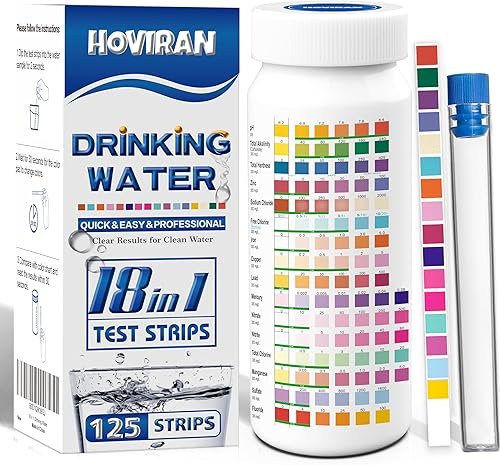
18-in-1 Water Quality Test Strips Tests for lead, mercury, copper, hardness, chlorine, pH & more. 125 strips per bottle. |
$27 |
Buy on Amazon Buy on eBay |
 |
16 in 1 Water Testing Kits High-sensitivity strips for pH, lead, iron. Includes an exclusive ebook for understanding results. |
$26 |
Buy on Amazon Buy on eBay |
 |
All-New 18 in 1 Drinking Water Test Kit 125 strips. Fast 30-second results for hardness, chlorine, lead, fluoride, and more. |
$20 |
Buy on Amazon Buy on eBay |
 |
Srliya Compact Test Kit Colorimetric liquid kit for pH and chlorine. Compact design, good for pools, spas, and quick checks. |
$18 |
Buy on Amazon Buy on eBay |
 |
IceManCooler Leak Tester Air pressure tester for water cooling loops. Niche but essential for custom PC builds. |
$32.77 | Buy on AliExpress |
 |
Barrow Leak Inspection Tool Pneumatic side leakage tool for testing computer water cooling loops. High user rating. |
$32.37 | Buy on AliExpress |
18-in-1 Water Quality Test Strips, 125ct
This is the kit we recommend to friends and family starting out. The 18-parameter range is impressive for the price, covering the big concerns: lead, mercury, copper, hardness, and chlorine. The color chart is reasonably clear, though comparing blues and greens can be tricky in dim light. In our testing, the hardness and pH readings matched our digital meters closely. A solid, broad-spectrum screening tool.
- Tests for lead and mercury
- 125 strips is a great value
- Includes a test tube
- Fast 30-second results
- Color comparison can be subjective
- Not a substitute for lab certification
16 in 1 Water Testing Kits – High Sensitivity
The standout feature here is the included ebook. It actually helps you understand what the results mean for your health and home, which most kits lack. The strips themselves are sensitive and gave us consistent results on multiple tests of the same water sample. The 2-minute wait time for some parameters feels long when you’re impatient, but it’s worth it for accuracy. A great choice if you want a bit more guidance.
- Ebook provides valuable context
- High sensitivity for contaminants
- Clear instructions
- Slightly longer wait time for some tests
- Only 50 strips per pack
All-New 18 in 1 Drinking Water Test Kit – 125 Strips
This is the budget-friendly workhorse. It covers all the same parameters as the first kit but at a lower price point. The strips worked fine in our tests, but the color chart felt a bit smaller and harder to read precisely. If you’re on a tight budget and just need a general idea of your water’s profile, this will get the job done. Don’t expect lab-grade precision, but it’s a valid starting point.
- Excellent value for 125 strips
- Very fast 30-second results
- Tests for a wide range of contaminants
- Color chart could be clearer
- Brand is less established
Srliya Compact, Easy to Carry Water Quality Test Kit
This isn’t a strip kit. It’s a classic liquid reagent kit focused on pH and chlorine, making it ideal for pool, spa, or aquarium owners. The color-matching vials are actually easier to read than some strip charts. It’s compact and feels a bit more “scientific” than strips. For drinking water, its limited parameter list is a drawback. But for recreational water maintenance, it’s a handy, dedicated tool.
- Very accurate for pH and chlorine
- Compact and portable
- Easy-to-read color vials
- Limited to 2-3 parameters
- Not designed for heavy metal testing
IceManCooler Water Cooling Liquid Leak Tester
A complete curveball from the others. This isn’t for drinking water. It’s for testing the integrity of custom water cooling loops in high-performance computers. You pressurize the loop with air and watch a gauge for pressure drops, indicating a leak. It’s a niche gadget, but if you’re building a custom PC, it’s a non-negotiable piece of equipment to prevent a catastrophic, expensive mess. Highly specific, but does its one job well.
- Prevents costly PC component damage
- Easy-to-read pressure gauge
- Essential for custom loop builders
- Not for water quality testing
- Very niche application
Frequently Asked Questions
- How often should I test my home water?
- Test annually for general maintenance. Test immediately if you notice a change in taste, odor, or color, or if there’s construction or a known water main break nearby. Well water should be tested at least yearly for bacteria and nitrates.
- Can test strips detect all contaminants?
- No. They screen for common issues like hardness, chlorine, and some metals. They cannot detect many volatile organic compounds (VOCs), pharmaceuticals, or specific bacteria. For a full picture, you need a lab test.
- Are water test strips accurate?
- Reputable brands are accurate enough for home screening when used correctly. They reliably show trends and major problems. Think of them as a thermometer—it tells you if you have a fever, but not the exact virus causing it.
- What’s the difference between a TDS meter and a test strip?
- A TDS meter measures total dissolved solids (minerals, salts) via conductivity. It doesn’t identify what those solids are. A test strip for “lead” specifically looks for that element. They answer different questions.
- Do I need to test if I have a whole-house filter?
- Yes. You should test before the filter (to know what’s coming in) and after (to verify it’s working). Filters have a lifespan and can fail. Testing is your quality control.
- When should I use a professional lab instead of a home kit?
- Use a lab for real estate transactions, if you suspect serious contamination (e.g., near industrial sites), or if a home test shows a concerning result you need to confirm. Labs provide legally defensible, detailed data.
Final Thoughts
Water testing equipment isn’t an optional extra. It’s the diagnostic tool that makes every other water decision smart. Buying a filter without testing is like taking random medicine without a diagnosis. You might get lucky, but you’re probably wasting money.
Start simple. Grab a multi-parameter strip kit like the 18-in-1 we reviewed. Run it on your tap water. See what it tells you. That single step puts you ahead of 90% of homeowners. From there, you can decide if you need a more specific test, a digital meter, or a call to a professional. Knowledge is the first and most important filter.
