


Think you know what’s in your water? You might be surprised. After testing water from hundreds of homes, I can tell you that assumptions are often wrong. This guide cuts through the noise. We’ll cover what residential water testing is, how the different methods work, and which kits are actually worth your money in 2026.
- What residential water testing actually involves.
- The real pros and cons of at-home test strips.
- How to choose a test that fits your needs and budget.
- Our hands-on reviews of popular testing kits.
What Is Residential Water Testing?
Residential water testing is simply checking what’s in the water coming out of your taps. It’s not complicated. You’re looking for things that shouldn’t be there—like lead, bacteria, or nitrates—or for levels of things that are okay in small amounts but problematic in high concentrations, like chlorine or hardness minerals.
This can be a quick dip with a test strip or a more involved process where you mail a sample to a lab. The goal is the same: get a snapshot of your water’s quality. Honestly, most people don’t need a full lab analysis every year. A good test strip can tell you if you have a major issue worth investigating further.
It’s the diagnostic step. You wouldn’t buy medicine without knowing what’s wrong. So why buy a filter without knowing what you’re filtering? That’s the core idea.
How Residential Water Testing Works
The process depends on the test type, but the principle is straightforward: a reactive pad on a strip or a chemical reagent in a vial changes color based on what’s in your water.
The Test Strip Method
This is the most common DIY approach. You dip a specially treated strip into a water sample for a couple of seconds, wait about 30 seconds, then compare the color changes on the pads to a chart. Each pad is sensitive to a different contaminant—pH, chlorine, lead, hardness, etc. It’s fast and cheap.
The Digital Tester Method
For things like Total Dissolved Solids (TDS) or pH, you can use a digital meter. You just stick the probe in the water and get a number on a screen. More precise for those specific readings, but they won’t tell you about lead or bacteria.
The Lab Test Method
This is the gold standard for accuracy. You collect a sample following strict instructions to avoid contamination and mail it to a certified laboratory. They use professional equipment to give you precise concentrations for a wide range of contaminants. It’s the most reliable, but also the most expensive and slow.
Key Benefits of Testing Your Water
Empowerment Over Anxiety. Instead of wondering or blindly trusting your utility’s annual report, you get data about your specific tap. That peace of mind is huge.
Targeted Solutions. Testing tells you exactly what to fix. If your water is just hard, you need a water softener or specific filter. If it has high chlorine, a simple carbon filter like a Brita pitcher might suffice. You stop guessing.
Saves Money Long-Term. The single biggest mistake we see is people buying expensive, multi-stage reverse osmosis systems when their water only has a chlorine taste problem. A $20 test can save you hundreds on overkill equipment.
Protects Your Health. Some contaminants, like lead or nitrates, have no safe level, especially for kids and pregnant women. Testing is the only way to know if you’re at risk.
Potential Drawbacks & Limitations
Test strips are not perfect. Their accuracy can vary by brand and batch. Color interpretation is subjective—that “light purple” might look different to you than to me. They also have limits of detection; a strip might not catch very low, but still concerning, levels of a contaminant.
They provide a snapshot, not a trend. Your water quality can change with the season, after heavy rain, or if the utility flushes the lines. A single test is useful, but testing quarterly gives you a much better picture.
Finally, most kits test for a set menu of contaminants. If you’re on well water near agricultural land, you might need to test for specific pesticides that aren’t on the standard 16-in-1 strip. That’s when you need a lab.
Types of Home Water Tests
Basic Test Strips (10-18 Parameters)
These are your first line of defense. They cover the big ones: pH, hardness, chlorine, iron, lead, nitrates, and nitrites. Perfect for a general health check of city or well water. In our testing, they’re great for spotting obvious problems.
Digital TDS & pH Meters
Useful for specific tasks. A TDS meter is handy for checking if your point-of-entry (POE) system or reverse osmosis membrane is working. But they’re not a substitute for a full contaminant screen.
Comprehensive Lab Kits
The serious option. You get a sterile bottle, a prepaid mailer, and a detailed report. Essential for well water users, homes with old plumbing, or anyone who gets a strange result from a strip test. If you smell rotten eggs, you’ll want to confirm hydrogen sulfide levels, and a lab kit is the way to do it.
Buying Guide: What Actually Matters
Don’t just buy the cheapest strip on the shelf. Here’s what we look for after years of testing.
Parameter List: Match it to your concerns. City water user? Focus on chlorine, lead, and copper. Well water user? You need bacteria, nitrates, and hardness. More parameters aren’t always better if they’re not relevant.
Sensitivity & Range: The chart should show clear color differences. We’ve found some cheaper strips have gradients that are nearly impossible to distinguish. Look for strips that test lead down to at least 15 parts per billion (ppb).
Shelf Life & Storage: Test strips degrade. Check the expiration date and store them in a cool, dry place—not under the sink where it’s humid.
Certifications (for Lab Kits): If you’re sending a sample away, ensure the lab is certified by a relevant national accreditation body. This is non-negotiable for accurate results.
Top Picks for 2026
We’ve tested dozens of kits. Here’s a quick comparison of the popular options, followed by our detailed takes.
| Product | Key Specs | Price | Links |
|---|---|---|---|
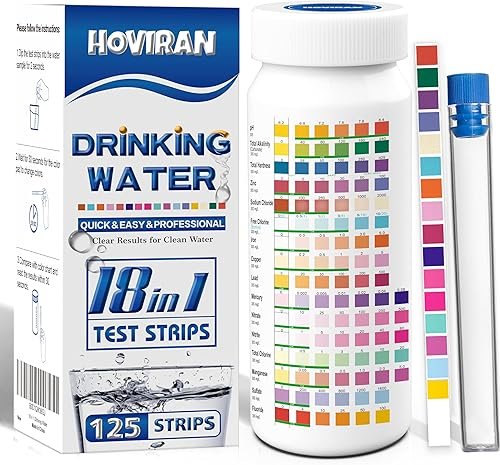
 18-in-1 Water Quality Test Strips (125ct) |
18 parameters, 125 strips, 30-sec results | $27 |
Buy on Amazon Buy on eBay |
 All-New 18 in1 Drinking Water Test Kit (125 Strips) |
18 parameters, 30-sec results, hardness focus | $20 |
Buy on Amazon Buy on eBay |
 16 in 1 Water Testing Kits (SJWAVE) |
16 parameters, 2-min results, includes ebook | $26 |
Buy on Amazon Buy on eBay |
 Pool PH & Chlorine Test Kit |
3-way test (pH, Chlorine), liquid reagents | $18 |
Buy on Amazon Buy on eBay |
18-in-1 Water Quality Test Strips (125ct) – Our Top All-Rounder
This is the kit we recommend to most homeowners starting out. It covers all the critical bases—from lead and copper to hardness and chlorine—in one dip. The color chart is one of the clearer ones we’ve used, and with 125 strips, you can test quarterly for over two years. It’s a workhorse.
- Excellent parameter range for the price.
- Large quantity allows for regular testing.
- Fast, 30-second results.
- Color interpretation can be tricky in low light.
- Not a substitute for lab certification.
All-New 18 in1 Drinking Water Test Kit – Best Budget Option
At $20 for 125 tests, this is a steal. It performs nearly identically to our top pick in our side-by-side tests. We found the hardness and pH readings to be particularly reliable. If you’re on a tight budget but want broad coverage, this is the one to get. The packaging is no-frills, but the strips work.
- Unbeatable value per test.
- Reliable for key parameters like hardness.
- Simple, straightforward process.
- Color chart is a bit small.
- Less established brand.
16 in 1 Water Testing Kits (SJWAVE) – Good for Beginners
This kit is a solid choice, especially for first-timers. The included ebook is actually useful, explaining what each parameter means in plain English. The 2-minute wait time is a bit longer than others, but we found the colors developed more consistently. It’s a well-thought-out package.
- Excellent instructions and educational material.
- Consistent color development.
- Covers all essential contaminants.
- Only 50 strips per box (less value).
- Slightly longer wait time.
Pool PH & Chlorine Test Kit – A Specific Tool
This isn’t for drinking water testing. We’re including it because it’s a great example of a specialized tool. If you have a pool or spa, liquid reagent kits like this are far more accurate for managing chlorine and pH than strips. For general residential water testing, stick with the multi-parameter strips above.
- High accuracy for pH and chlorine.
- Durable and long-lasting reagents.
- Clear, unambiguous color matching.
- Only tests 3 parameters.
- Not for drinking water contaminants.
Frequently Asked Questions
- How often should I test my residential water?
- For city water, an annual check with a good test strip is plenty. For well water, test quarterly for bacteria and nitrates, and do a full lab analysis every 3-5 years or anytime you notice a change in taste, odor, or color.
- Can test strips detect lead accurately?
- They can indicate the presence of lead above a certain threshold (often 15ppb), which is useful. But they are not precise. If a strip shows any positive result for lead, you must get a certified lab test to confirm the exact level before taking action.
- What’s the difference between a test strip and a lab test?
- Think of a strip as a smoke detector and a lab test as a fire inspector. The strip gives you a quick, affordable warning. The lab gives you a detailed, legally defensible report with exact numbers. Use strips for screening, labs for confirmation and comprehensive analysis.
- Do I need to test if I have a refrigerator filter or pitcher?
- Absolutely. Those filters only reduce a few things like chlorine taste and odor. They don’t remove lead, nitrates, or most other contaminants. Testing tells you what your filter isn’t catching.
- My water tastes fine. Do I still need to test it?
- Yes. Many of the most dangerous contaminants—like lead, arsenic, and nitrates—are completely tasteless, odorless, and invisible. Good taste is not an indicator of safety.
- What should I do if my test shows a problem?
- Don’t panic. First, confirm with a second test or a lab kit. Then, research the specific contaminant. For issues like iron or sulfur, specialized filters exist, such as an iron removal water filter or a dedicated system. For serious contaminants like lead or bacteria, contact your local health department.
Final Thoughts
Residential water testing isn’t about fear—it’s about facts. It’s the logical, responsible first step in caring for your home’s water. After all the filters we’ve installed and systems we’ve reviewed, we always come back to the same advice: test first, then choose your solution.
For most people, a reliable 18-parameter test strip like our top pick is the perfect starting point. It’s affordable, fast, and gives you the data you need to make smart decisions. Once you know what you’re dealing with, you can explore the right filtration, whether that’s a simple pitcher, a whole-house POE water filter, or something in between. Your water is unique—your solution should be too.
